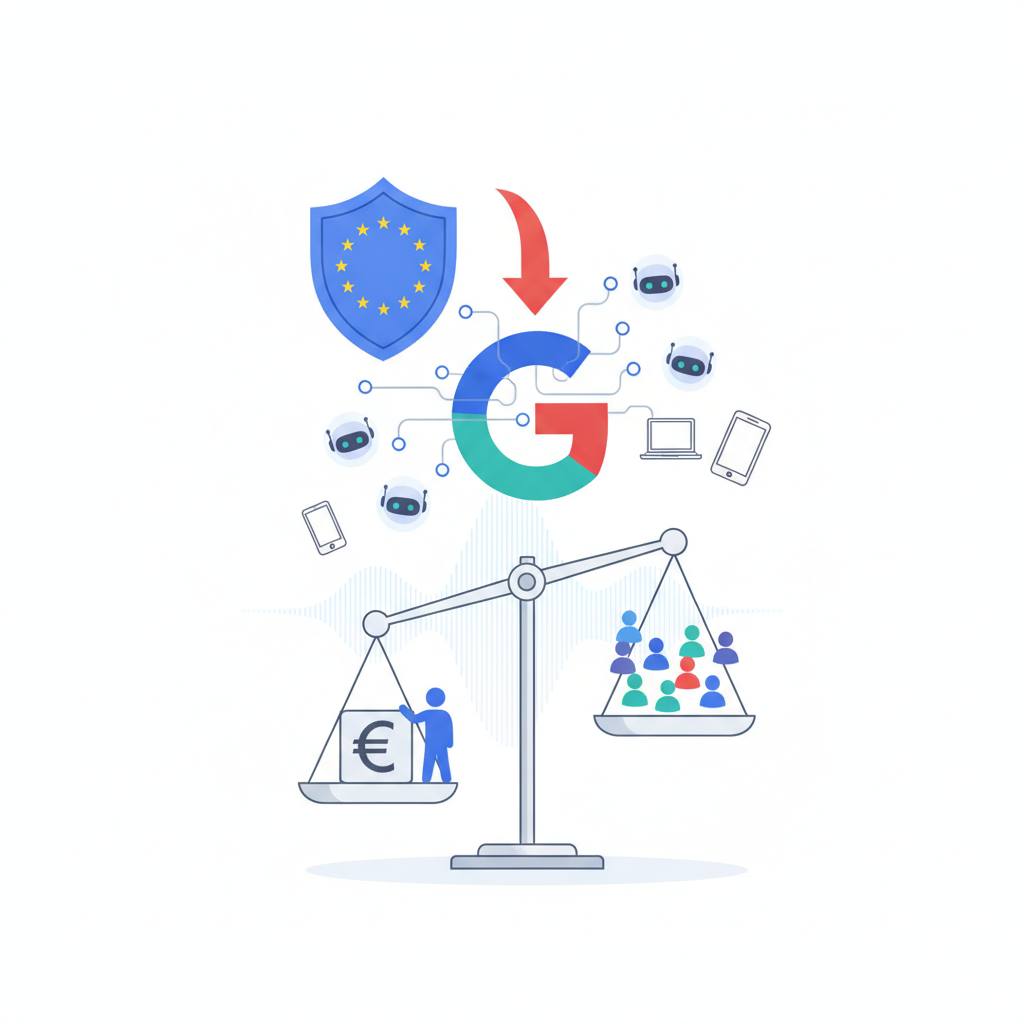
The EU's massive fine on Google for its AI search practices highlights the importance of fair competition. We'll explore why bundling features can hurt rivals and limit consumer choices.
Did you hear the news? The European Union just gave Alphabet (Google's parent company) a massive $1.2 billion fine. This wasn't about data privacy or security; it was about something called 'fair competition,' especially concerning how Google uses Artificial Intelligence, or AI, in its search results. But what does that even mean for you and me?
Imagine Google Search like a giant supermarket. It's the biggest one in town, and almost everyone shops there. Recently, Google started offering 'AI Overviews' – smart summaries generated by AI, right at the top of your search results. Think of it as the supermarket's own brand of super-fast, pre-made meals. The EU says that by automatically putting these AI Overviews with its standard search results, Google is acting unfairly.
Here's why: If you go to a supermarket, you expect to see many different brands of juice, cereal, or bread, right? That's competition at work. Different companies try to offer the best product at the best price. But if the biggest supermarket owner forces you to buy *only* its own brand of juice every time you buy bread, even if you prefer another brand, that's not fair. Other juice companies can't get their products seen or sold.
That's similar to what the EU believes Google did. Google holds a 'dominant position' in search – meaning it's by far the most popular. By 'bundling' its AI-driven features (the 'AI Overviews') directly into the main search experience, it makes it incredibly hard for other search engines, especially smaller startups or even rivals like Bing, to get noticed. These competitors might have innovative AI features too, or simply better traditional search results, but if Google's own AI answers are always presented first and prominently, users might not bother looking elsewhere.
Why is this a problem? For us, the consumers, it means less choice. If competitors can't get a fair chance to show off their innovations, they might struggle to grow or even disappear. This means less variety, potentially slower innovation across the internet, and perhaps even higher prices in the long run if one company has too much control. The EU's message is clear: no company, no matter how big, should use its power to stifle competition. They want to ensure that the internet remains a place where new ideas can thrive and consumers always have options, ensuring a healthier digital market for everyone.
Imagine Google Search like a giant supermarket. It's the biggest one in town, and almost everyone shops there. Recently, Google started offering 'AI Overviews' – smart summaries generated by AI, right at the top of your search results. Think of it as the supermarket's own brand of super-fast, pre-made meals. The EU says that by automatically putting these AI Overviews with its standard search results, Google is acting unfairly.
Here's why: If you go to a supermarket, you expect to see many different brands of juice, cereal, or bread, right? That's competition at work. Different companies try to offer the best product at the best price. But if the biggest supermarket owner forces you to buy *only* its own brand of juice every time you buy bread, even if you prefer another brand, that's not fair. Other juice companies can't get their products seen or sold.
That's similar to what the EU believes Google did. Google holds a 'dominant position' in search – meaning it's by far the most popular. By 'bundling' its AI-driven features (the 'AI Overviews') directly into the main search experience, it makes it incredibly hard for other search engines, especially smaller startups or even rivals like Bing, to get noticed. These competitors might have innovative AI features too, or simply better traditional search results, but if Google's own AI answers are always presented first and prominently, users might not bother looking elsewhere.
Why is this a problem? For us, the consumers, it means less choice. If competitors can't get a fair chance to show off their innovations, they might struggle to grow or even disappear. This means less variety, potentially slower innovation across the internet, and perhaps even higher prices in the long run if one company has too much control. The EU's message is clear: no company, no matter how big, should use its power to stifle competition. They want to ensure that the internet remains a place where new ideas can thrive and consumers always have options, ensuring a healthier digital market for everyone.