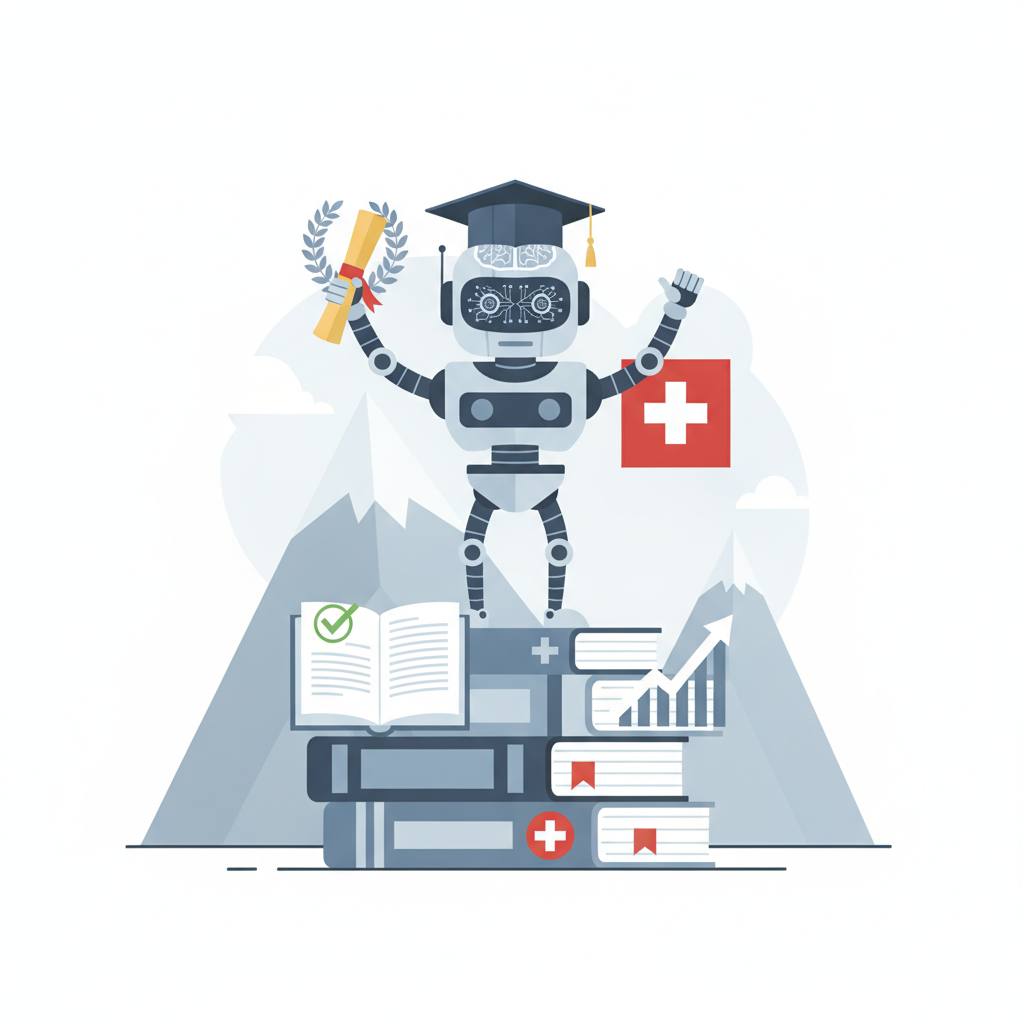
The AI model Darwin-180B-RSI has achieved an astonishing feat by topping tough Swiss law exams, despite never being trained on legal data. This breakthrough highlights AI's remarkable capacity for self-improvement and complex reasoning in new domains.
Did you know that an AI has managed to top tough Swiss law exams without ever being trained in law? Yes, that's exactly what happened with the Darwin-180B-RSI model, and for all of us, this means AI's capabilities are far greater than we imagined.
This model, developed by the Korean startup VIDRAFT, a large 180B parameter model, recently shot to the top of both the LEXam and LEXam-hard leaderboards. These are official benchmarks for legal reasoning ability, as listed by Hugging Face.
The really surprising part is that Darwin-180B-RSI was never trained on any legal data. Yet, it now holds first place on seven official Hugging Face leaderboards, which is more than any other organization currently. This achievement easily outperforms even top-tier models like GPT-5, Claude-4.5-Sonnet, and Gemini-2.5-Pro, scoring an impressive 68.94 points on LEXam compared to GPT-5’s 62.65.
So, what makes this test so challenging? The LEXam exam was created by researchers from ETH Zurich, the University of Zurich, and the Max Planck Institute. It's built from 340 real law-school exams from Swiss universities, available in both German and English. Crucially, it doesn't test whether an AI has simply memorized legal statutes. Instead, it tests the model's ability to apply legal principles to a set of facts and reason its way to a conclusion, just like a human law student or lawyer would.
How did Darwin-180B-RSI manage this impressive feat? The secret lies in its unique operating method: 'model-level recursive self-improvement.' Simply put, the model solves practice problems, then learns and improves its own performance automatically, without needing direct training on specific datasets.
This accomplishment truly opens new doors for what AI can achieve. It shows that AI is no longer limited to fields where it's been specifically trained. Think about it: if AI can understand and apply complex legal principles in this way, what other areas might it soon excel in, thanks to its ability to self-learn? This development changes our understanding of how machines can learn and adapt to tasks they weren't explicitly programmed for.
This model, developed by the Korean startup VIDRAFT, a large 180B parameter model, recently shot to the top of both the LEXam and LEXam-hard leaderboards. These are official benchmarks for legal reasoning ability, as listed by Hugging Face.
The really surprising part is that Darwin-180B-RSI was never trained on any legal data. Yet, it now holds first place on seven official Hugging Face leaderboards, which is more than any other organization currently. This achievement easily outperforms even top-tier models like GPT-5, Claude-4.5-Sonnet, and Gemini-2.5-Pro, scoring an impressive 68.94 points on LEXam compared to GPT-5’s 62.65.
So, what makes this test so challenging? The LEXam exam was created by researchers from ETH Zurich, the University of Zurich, and the Max Planck Institute. It's built from 340 real law-school exams from Swiss universities, available in both German and English. Crucially, it doesn't test whether an AI has simply memorized legal statutes. Instead, it tests the model's ability to apply legal principles to a set of facts and reason its way to a conclusion, just like a human law student or lawyer would.
How did Darwin-180B-RSI manage this impressive feat? The secret lies in its unique operating method: 'model-level recursive self-improvement.' Simply put, the model solves practice problems, then learns and improves its own performance automatically, without needing direct training on specific datasets.
This accomplishment truly opens new doors for what AI can achieve. It shows that AI is no longer limited to fields where it's been specifically trained. Think about it: if AI can understand and apply complex legal principles in this way, what other areas might it soon excel in, thanks to its ability to self-learn? This development changes our understanding of how machines can learn and adapt to tasks they weren't explicitly programmed for.