Learn from developers' experiences: when your applications encounter issues, first identifying the source of the error – whether it's from your code, an external service, or the infrastructure – saves you time and effort and makes the fixing process more efficient.
Our story begins with a programmer facing a significant challenge: their applications, which used AI models, kept failing repeatedly. They spent long hours, sometimes up to 48 hours, trying to pinpoint the cause of each outage. Was the problem in the code they wrote? In the AI model itself they were interacting with? Or in the server hosting everything?
Typically, when developers encounter an error in their software, their first thought is, 'It must be my code!' This often leads them to rewrite perfectly fine parts of their code repeatedly, believing the fault lies there. Imagine trying to fix a broken water faucet in your home by replacing the faucet three times, only to discover the real issue was a city-wide water outage! This is exactly what was happening to the programmer, who rewrote a perfectly fine function three times while the actual cause of the application's failure was a server that occasionally hiccuped for five seconds.
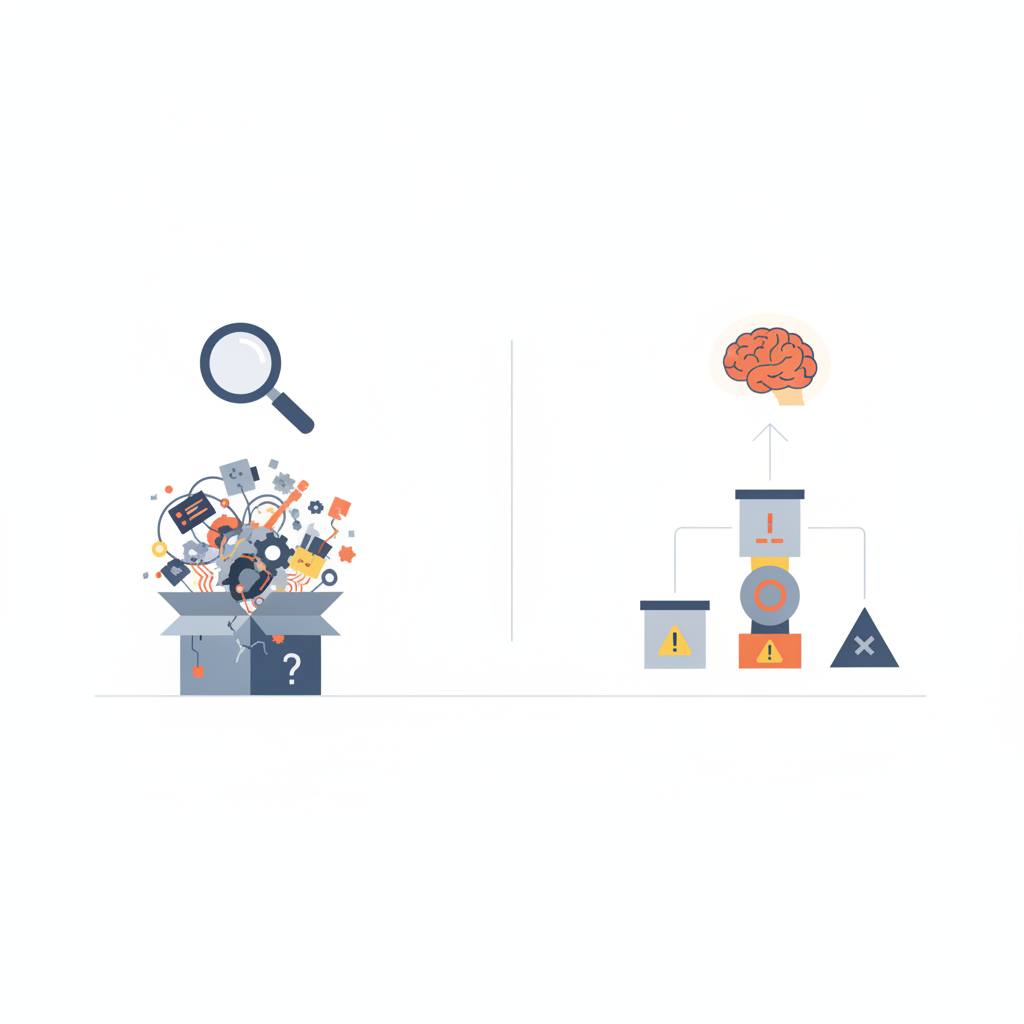
This is where the crucial lesson comes in: before you start fixing anything, you must first classify the failure. The programmer we mentioned discovered this and built a 'simple verdict machine' to sort problems into three main categories:
1. **Your Own Code:** Is there a mistake in how you wrote your instructions, or in the logic you followed? This includes errors in data formatting or a bug in your application's flow.
2. **External Service/Model Error:** Is the issue not with you, but with the AI service you are using, or the API you are calling? Perhaps the service experienced a temporary glitch, or returned an unexpected response.
3. **Server/Infrastructure Error:** Is the problem deeper, such as a network interruption, or a breakdown in the server hosting your application? This covers issues like server downtime or connectivity problems.
When you classify failures this way, you transform the debugging process from a 'guessing game' into an 'organized checklist'. Instead of spending hours searching in the wrong place, you can go directly to the potential source of the problem. This saves valuable time, reduces frustration, and ensures you're not trying to fix something that isn't broken.
Whether you're a beginner programmer or an experienced one, adopting this systematic approach to classifying errors will entirely change how you deal with problems. Always remember: correct diagnosis is half the solution.
Typically, when developers encounter an error in their software, their first thought is, 'It must be my code!' This often leads them to rewrite perfectly fine parts of their code repeatedly, believing the fault lies there. Imagine trying to fix a broken water faucet in your home by replacing the faucet three times, only to discover the real issue was a city-wide water outage! This is exactly what was happening to the programmer, who rewrote a perfectly fine function three times while the actual cause of the application's failure was a server that occasionally hiccuped for five seconds.
This is where the crucial lesson comes in: before you start fixing anything, you must first classify the failure. The programmer we mentioned discovered this and built a 'simple verdict machine' to sort problems into three main categories:
1. **Your Own Code:** Is there a mistake in how you wrote your instructions, or in the logic you followed? This includes errors in data formatting or a bug in your application's flow.
2. **External Service/Model Error:** Is the issue not with you, but with the AI service you are using, or the API you are calling? Perhaps the service experienced a temporary glitch, or returned an unexpected response.
3. **Server/Infrastructure Error:** Is the problem deeper, such as a network interruption, or a breakdown in the server hosting your application? This covers issues like server downtime or connectivity problems.
When you classify failures this way, you transform the debugging process from a 'guessing game' into an 'organized checklist'. Instead of spending hours searching in the wrong place, you can go directly to the potential source of the problem. This saves valuable time, reduces frustration, and ensures you're not trying to fix something that isn't broken.
Whether you're a beginner programmer or an experienced one, adopting this systematic approach to classifying errors will entirely change how you deal with problems. Always remember: correct diagnosis is half the solution.