Developers of the free logic simulator Boolflow are introducing a new technique called 'flattening' to simplify complex circuit designs, making simulation smoother and more accurate.
The developers behind Boolflow, a free browser-based logic simulator, are introducing a clever technique called 'flattening' to simplify complex circuit designs. For you, this means a smoother, more accurate simulation experience, especially when dealing with sub-components. Boolflow is a free logic simulator that runs directly in your browser, making it a powerful tool for engineers and designers alike.
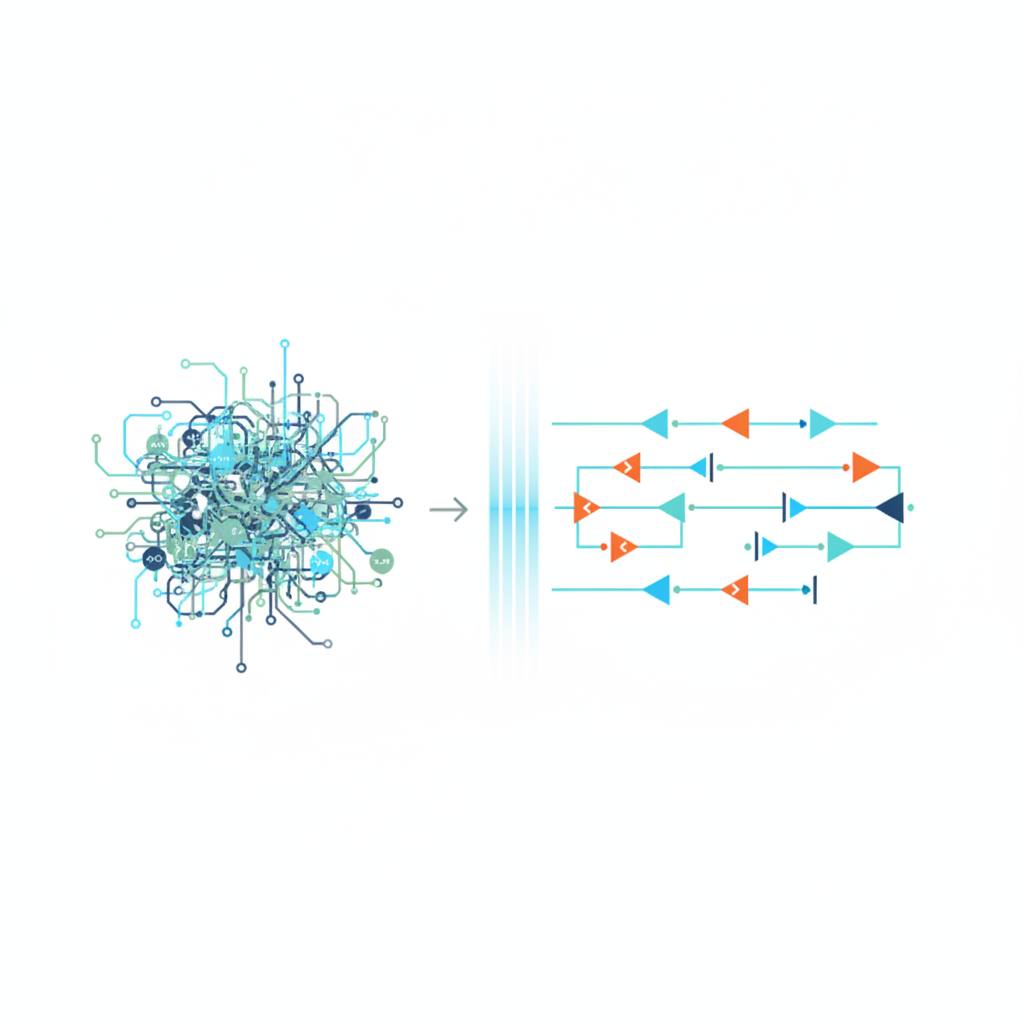
The core of this latest innovation revolves around 'blocks,' which are essentially encapsulated sub-circuits within a single definition. Before any simulation begins, Boolflow performs an interesting 'flattening' process: it replaces each block with a full copy of its internal definition. Imagine taking a complex LEGO build apart into its original pieces before reassembling them as one flat model. The result is a single, entirely 'flat' circuit, ready for simulation without any additional structural complexity.
This method isn't just about simplification; it ensures the simulator treats the entire circuit as a cohesive whole. Crucially, it manages identification (ID) meticulously. When blocks are nested, as they often are in intricate logic circuits, paths (like DIV2/D.Q) are used to spell out this nesting clearly, making it easy to track the state of any circuit part. Even the inputs and outputs—referred to as 'pins'—within these sub-circuits are carefully managed, with each pin's position identified to ensure proper wiring connections.
The benefits of 'flattening' don't stop at simulation. They extend to exporting the final circuit design to popular hardware description languages like Verilog and VHDL, and even to C++ code. This means your designs in Boolflow can be more easily transferred to other professional development environments, saving significant time and effort.
However, there are some rules for creating these sub-blocks. For instance, a block cannot contain a 'CLOCK' directly inside it; the clock must be fed in through an external input pin to ensure precise timing control. Boolflow's developers continue to refine these features, and they've transparently noted that they even discovered a bug during the writing of this system, underscoring the iterative nature of ongoing development. This promising technique makes designing and simulating logic circuits more robust and user-friendly.