Node.js developers often struggle with combining ESM and CommonJS modules. New research shows that understanding how Node.js classifies files and then loads modules is key to solving common issues like 'require is not defined' errors.
Ever hit a 'require is not defined' error in Node.js, switched it to an `import`, only to find a syntax error somewhere else? If you're mixing ESM and CommonJS modules, you're not alone. This challenge is confusing, and simply changing your syntax rarely fixes the root cause.
Recent research highlights a better approach: separate how Node.js *classifies* a file (is it ESM or CommonJS?) from how that file then *loads* other modules. Understanding this distinction helps you pinpoint whether you need to change your `package.json`, a filename extension, or even the asynchronous boundary of your caller.
Node.js uses several methods to classify files:
* **File Extensions:** Files ending in `.mjs` are classified as ESM, and those ending in `.cjs` are classified as CommonJS. These are clear-cut.
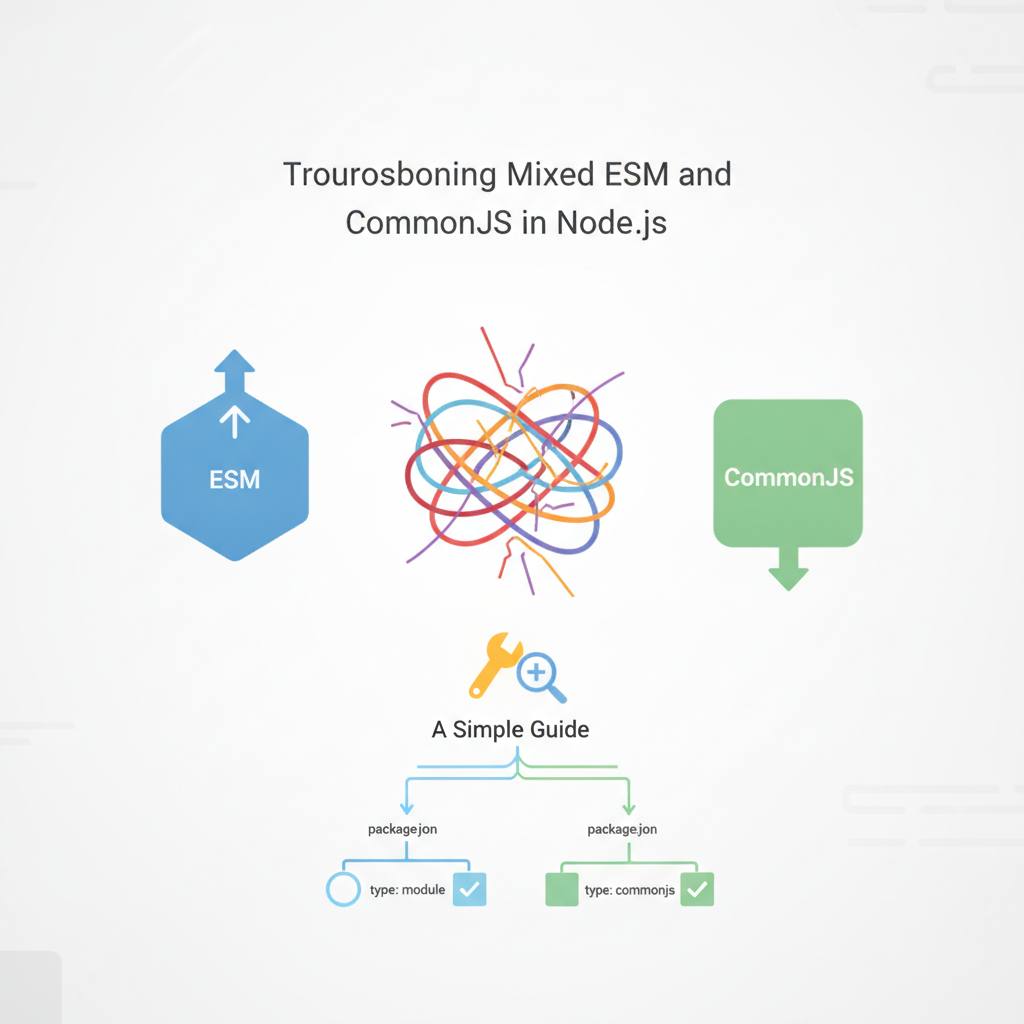
* **`package.json`:** For regular `.js` files, the `type` field in the *nearest* `package.json` file plays a crucial role. It can be `type: module` for ESM or `type: commonjs` for CommonJS. It's super important to note that 'nearest' matters: a `package.json` in a subdirectory can override a setting from a parent directory.
* **Syntax Detection:** Even without an explicit classification, Node.js can treat a `.js` file as ESM if it contains ESM-only syntax, like `export`.
What this means for you: Don't just blindly swap `require` for `import` or vice-versa. Instead, pause and ask: How is this file *classified*? And how does this file *load* other modules? Check your `package.json`'s `type` field, not just in your project root, but also in any nested directories you might have. If you're using `.js` files, consider using `.mjs` or `.cjs` to make things clearer and avoid ambiguity. Remember that assuming omitting the `type` field always means the old CommonJS behavior is incomplete for current Node.js versions. These findings are based on experiments with Node.js v24.15.0, so be aware that behaviors might evolve with newer versions.
By separating your thinking about module classification from module loading, you can navigate the complexities of ESM and CommonJS in Node.js more effectively and reduce those head-scratching runtime errors.
Recent research highlights a better approach: separate how Node.js *classifies* a file (is it ESM or CommonJS?) from how that file then *loads* other modules. Understanding this distinction helps you pinpoint whether you need to change your `package.json`, a filename extension, or even the asynchronous boundary of your caller.
Node.js uses several methods to classify files:
* **File Extensions:** Files ending in `.mjs` are classified as ESM, and those ending in `.cjs` are classified as CommonJS. These are clear-cut.
* **`package.json`:** For regular `.js` files, the `type` field in the *nearest* `package.json` file plays a crucial role. It can be `type: module` for ESM or `type: commonjs` for CommonJS. It's super important to note that 'nearest' matters: a `package.json` in a subdirectory can override a setting from a parent directory.
* **Syntax Detection:** Even without an explicit classification, Node.js can treat a `.js` file as ESM if it contains ESM-only syntax, like `export`.
What this means for you: Don't just blindly swap `require` for `import` or vice-versa. Instead, pause and ask: How is this file *classified*? And how does this file *load* other modules? Check your `package.json`'s `type` field, not just in your project root, but also in any nested directories you might have. If you're using `.js` files, consider using `.mjs` or `.cjs` to make things clearer and avoid ambiguity. Remember that assuming omitting the `type` field always means the old CommonJS behavior is incomplete for current Node.js versions. These findings are based on experiments with Node.js v24.15.0, so be aware that behaviors might evolve with newer versions.
By separating your thinking about module classification from module loading, you can navigate the complexities of ESM and CommonJS in Node.js more effectively and reduce those head-scratching runtime errors.