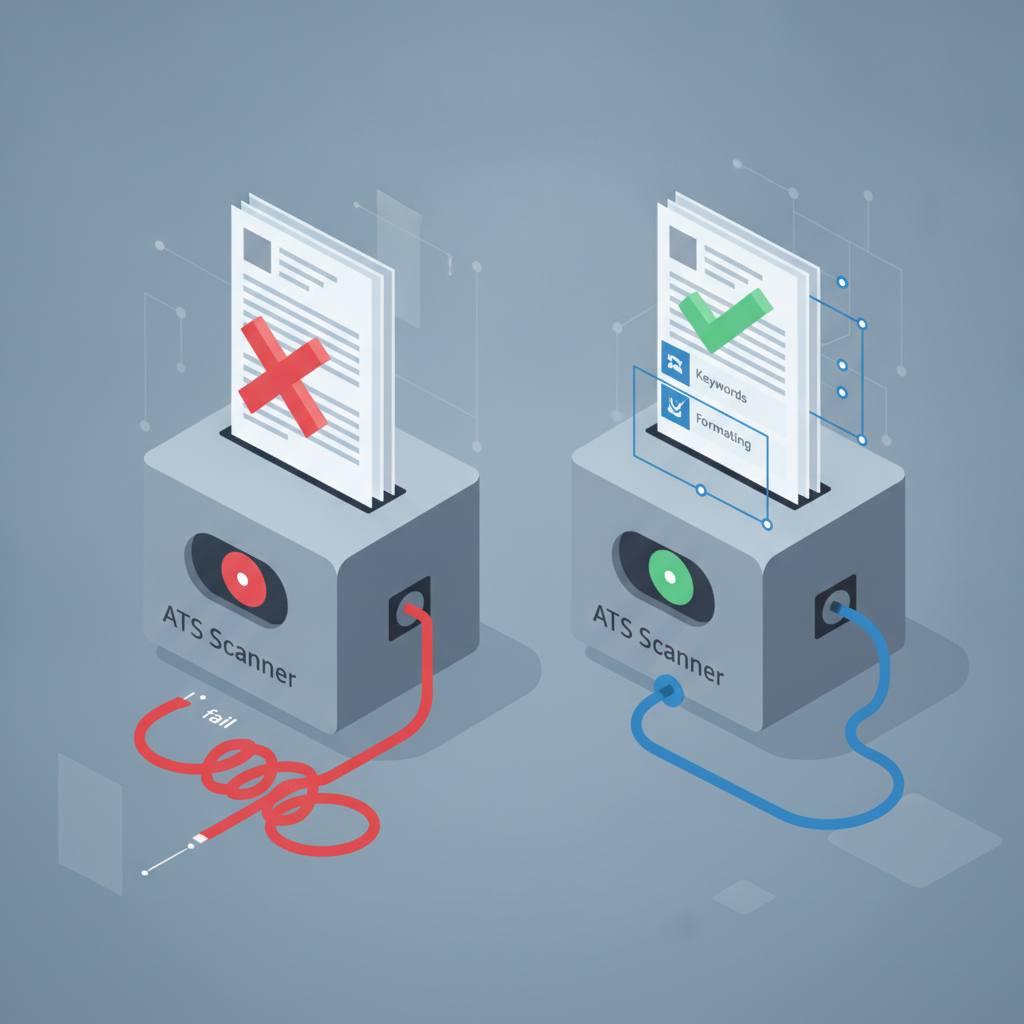
Did you know your engineering resume might never reach a human? Applicant Tracking Systems (ATS) often reject complex designs, causing you to miss out on opportunities.
If you're a qualified engineer struggling to get callbacks after applying for your dream job, the problem might not be your qualifications. Often, your resume isn't making it past Applicant Tracking Systems (ATS) – the automated gatekeepers that scan most job applications before any human sees them.
What does this mean for you? It means your resume's design could be its biggest enemy in your job search. These systems don't «read» like a person; they «parse» your document, ripping text out and trying to slot it into predefined fields like name, title, skills, and experience. If your resume is designed like a sleek portfolio, the parser often mangles it, turning your application into unreadable gibberish.
Here's the uncomfortable truth: the fanciest resume template is often the worst one for getting hired. Think of the parser as a very literal, very simple reader. It goes top to bottom, left to right, extracting plain text. Anything that isn't plain text in a single column confuses it.
1. **Multi-column layouts scramble your content:** Those elegant two-column templates – perhaps with a skills sidebar on the left and experience on the right – often lead to disaster. The ATS reads them as a single, interleaved stream of text. Your 'React' skill from the sidebar might suddenly appear in the middle of a job bullet point. Some parsers try to reconstruct the order and fail; the result is a jumbled mess no recruiter will bother trying to decode.
2. **Tables, text boxes, and graphics are invisible or garbled:** Parsers frequently can't read text inside tables or text boxes at all. Your carefully formatted experience section could appear empty. Icons, skill-bar charts, and even your professional headshot are worse than useless; the system ignores them entirely, meaning a human never gets the chance to see them because the parsing failed first.
3. **Headers and footers get skipped:** Some parsers ignore header and footer content entirely. If your name, phone number, and email live in the header, the system may file your application with no contact info attached. Keep everything in the main body of the document.
4. **Non-standard fonts and sloppy filenames create friction:** Decorative or custom fonts can fail to embed or render correctly, and unprofessional filenames can create friction, preventing the system from processing your content efficiently.
To fix this, think of the ATS parser as a very literal, very simple reader. Stick to a simple, single-column layout with plain text, flowing logically from top to bottom, left to right. Move all important information into the main body of the document and avoid graphic complexities. With these simple tweaks, you give your resume the best chance to bypass the ATS and land in front of a human, often in just 20 minutes.
What does this mean for you? It means your resume's design could be its biggest enemy in your job search. These systems don't «read» like a person; they «parse» your document, ripping text out and trying to slot it into predefined fields like name, title, skills, and experience. If your resume is designed like a sleek portfolio, the parser often mangles it, turning your application into unreadable gibberish.
Here's the uncomfortable truth: the fanciest resume template is often the worst one for getting hired. Think of the parser as a very literal, very simple reader. It goes top to bottom, left to right, extracting plain text. Anything that isn't plain text in a single column confuses it.
1. **Multi-column layouts scramble your content:** Those elegant two-column templates – perhaps with a skills sidebar on the left and experience on the right – often lead to disaster. The ATS reads them as a single, interleaved stream of text. Your 'React' skill from the sidebar might suddenly appear in the middle of a job bullet point. Some parsers try to reconstruct the order and fail; the result is a jumbled mess no recruiter will bother trying to decode.
2. **Tables, text boxes, and graphics are invisible or garbled:** Parsers frequently can't read text inside tables or text boxes at all. Your carefully formatted experience section could appear empty. Icons, skill-bar charts, and even your professional headshot are worse than useless; the system ignores them entirely, meaning a human never gets the chance to see them because the parsing failed first.
3. **Headers and footers get skipped:** Some parsers ignore header and footer content entirely. If your name, phone number, and email live in the header, the system may file your application with no contact info attached. Keep everything in the main body of the document.
4. **Non-standard fonts and sloppy filenames create friction:** Decorative or custom fonts can fail to embed or render correctly, and unprofessional filenames can create friction, preventing the system from processing your content efficiently.
To fix this, think of the ATS parser as a very literal, very simple reader. Stick to a simple, single-column layout with plain text, flowing logically from top to bottom, left to right. Move all important information into the main body of the document and avoid graphic complexities. With these simple tweaks, you give your resume the best chance to bypass the ATS and land in front of a human, often in just 20 minutes.