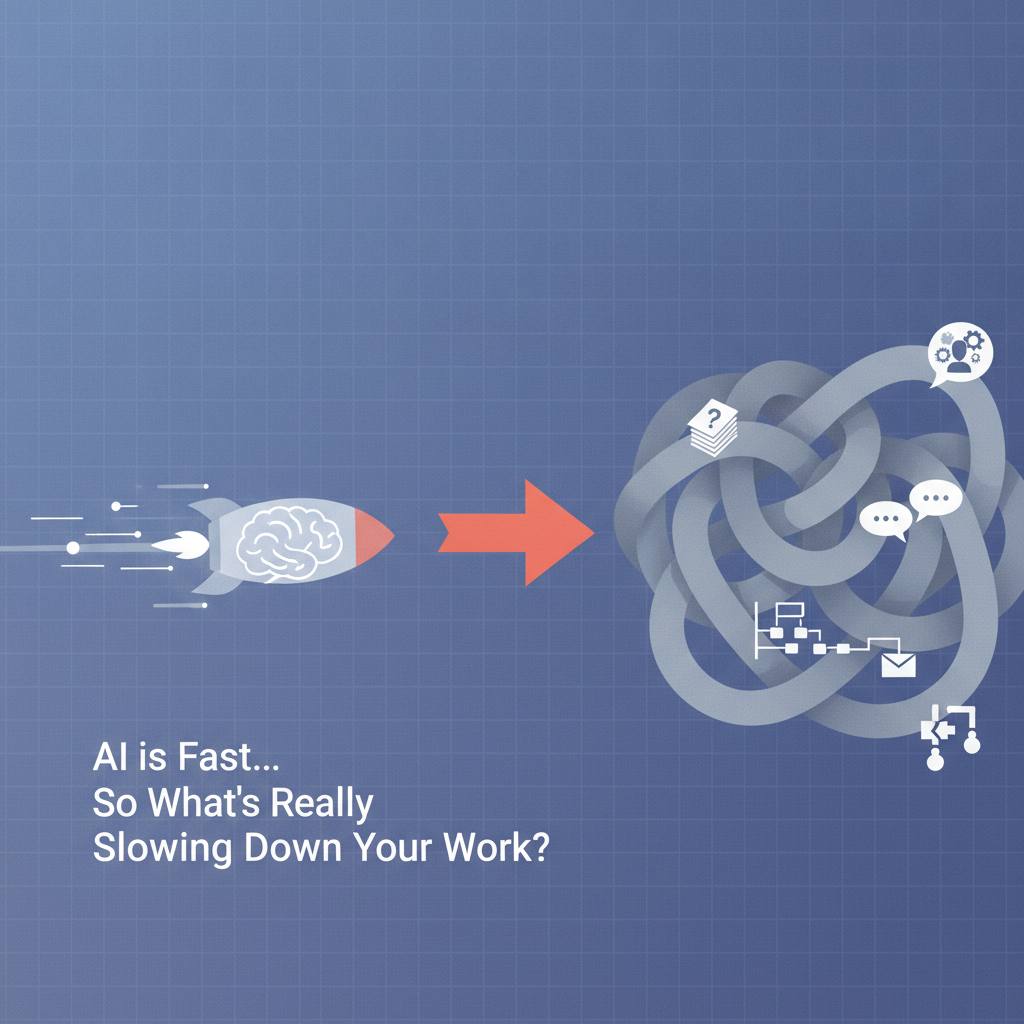
AI can draft documents quickly, but work often gets delayed by crucial human steps like review, verification, and approvals. This highlights that partial automation doesn't always solve complex workflow issues.
Have you ever noticed that even when you use powerful AI tools at work, tasks still seem to take a long time to complete? This is a real problem many businesses face today. Let's look at an example from the news: A company is preparing a complex document with 180 questions. The team uses AI to draft it quickly, and by the afternoon, most of the work is done. Great, right?
But here's the twist: two days later, the document still hasn't been sent! Why? Because some answers were outdated, others needed legal approval, and one product question had no clear owner. This is where a human comes in. You have to step in, find the right people, and chase the remaining decisions to get the work finished. In the end, the approved document reaches the buyer, not much faster than before, even though AI saved significant time in the initial drafting.
The core idea here is simple: AI is excellent at 'doing' specific, rapid tasks, like drafting text or gathering initial information. It's like a skilled driver with a fast car. But humans are still needed to 'verify' that the document is accurate, correct, and up-to-date, to 'approve' the content, and to 'coordinate' between different departments. In any complex work process, there are many steps beyond just drafting: thinking, judging, verifying, approving, and communicating.
Imagine building a house. Large machines can lay bricks incredibly fast – they're like AI. But you still need the architect to approve the blueprints, specialized technicians to install electricity and plumbing, and a city inspector to ensure everything is safe and legal. The speed of brick-laying alone won't build the whole house quickly, because there are other crucial human steps that a machine cannot do.
So, even with AI, your human role remains central to ensuring the work is accurate, effective, and gets the necessary approvals. AI is a very powerful tool, but it doesn't eliminate the need for human judgment, coordination, and review. When we think about investing in AI, we need to consider the entire workflow, not just one isolated task.
But here's the twist: two days later, the document still hasn't been sent! Why? Because some answers were outdated, others needed legal approval, and one product question had no clear owner. This is where a human comes in. You have to step in, find the right people, and chase the remaining decisions to get the work finished. In the end, the approved document reaches the buyer, not much faster than before, even though AI saved significant time in the initial drafting.
The core idea here is simple: AI is excellent at 'doing' specific, rapid tasks, like drafting text or gathering initial information. It's like a skilled driver with a fast car. But humans are still needed to 'verify' that the document is accurate, correct, and up-to-date, to 'approve' the content, and to 'coordinate' between different departments. In any complex work process, there are many steps beyond just drafting: thinking, judging, verifying, approving, and communicating.
Imagine building a house. Large machines can lay bricks incredibly fast – they're like AI. But you still need the architect to approve the blueprints, specialized technicians to install electricity and plumbing, and a city inspector to ensure everything is safe and legal. The speed of brick-laying alone won't build the whole house quickly, because there are other crucial human steps that a machine cannot do.
So, even with AI, your human role remains central to ensuring the work is accurate, effective, and gets the necessary approvals. AI is a very powerful tool, but it doesn't eliminate the need for human judgment, coordination, and review. When we think about investing in AI, we need to consider the entire workflow, not just one isolated task.