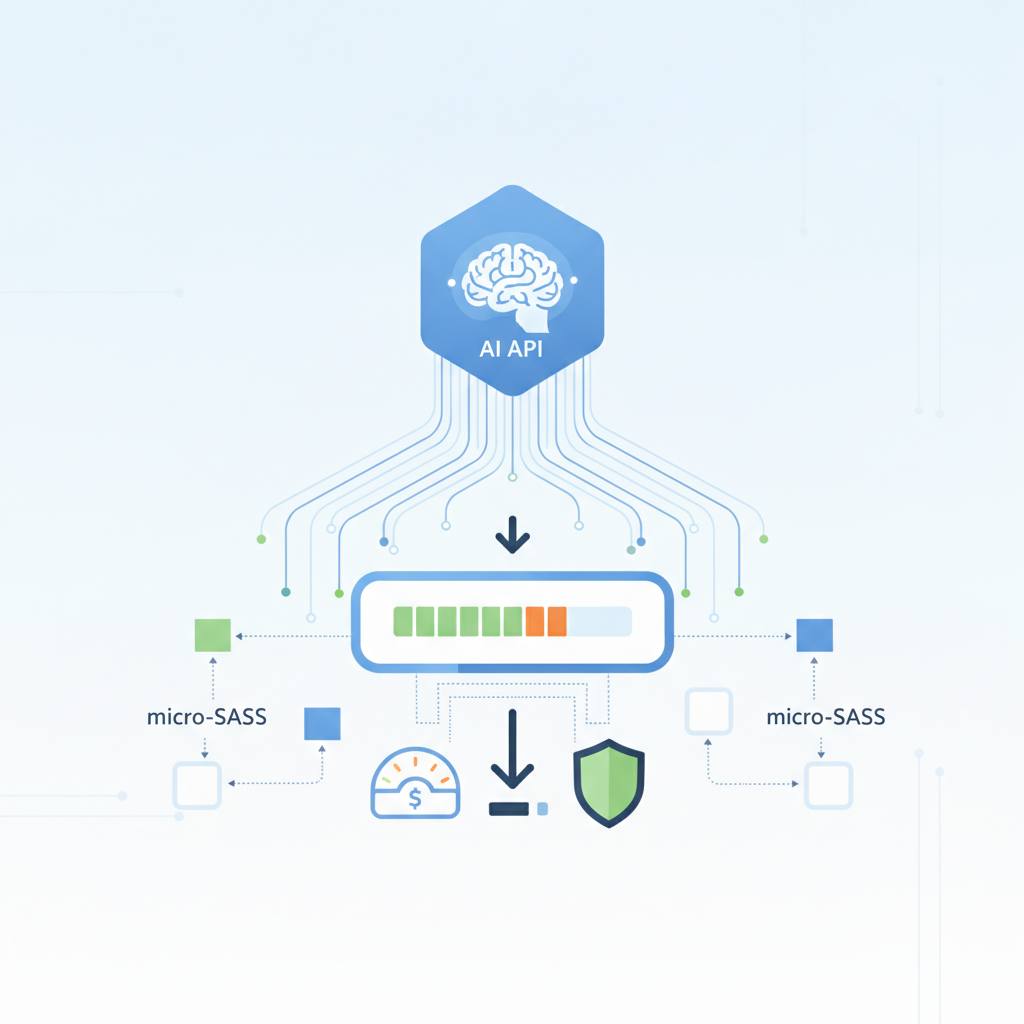
Unexpectedly high bills from AI API usage can cripple Next.js micro-SaaS projects; this post provides guidance on how to control these costs by properly separating the user interface from AI orchestration.
Have you ever been hit with a shocking $1,400 bill at 3 AM on a Sunday because a mobile user tapped 'Generate' four times on a flaky cellular connection? This isn't a hypothetical scenario; it's a reality many developers face in AI-powered micro-SaaS projects. The core issue isn't that a single AI inference call is too expensive, but rather a lack of clear boundaries separating user intent from how the system orchestrates AI requests, including retries and accounting ledgers.
What this means for you is that managing AI API spend requires more than simple monitoring. You need to make AI execution observable, cacheable, and budget-constrained. Crucially, this must be done without leaking billing logic into your UI components. The challenge is to build a system that prevents excessive, unthrottled requests and ensures every AI call is handled wisely and cost-effectively.
One tool that has emerged in this context is Cordis, described as a «Meta-Framework of Spatiotemporal Composability». However, it's important to note that its documentation explicitly warns that the core APIs remain in active development and may change without notice. Therefore, Cordis should not be treated as an unvetted, drop-in replacement for mature background queues or financial ledgers; doing so introduces unnecessary operational risk.
Instead, it's advisable to treat Cordis as an internal orchestration boundary, isolating it behind a strict application adapter. This approach allows you to benefit from its capabilities without being exposed to the risks of unexpected API changes. For a production-ready AI request path, it's recommended to segment the work into four distinct operational tiers.
These tiers begin with the «Next.js 15 Route Handler,» which validates authentication, enforces payload boundaries, and performs upfront quota admission checks. Next is the «Application Service,» which translates business domain operations, like summarizing documents, into model parameters; the frontend should never select model providers, configure temperature, or touch pricing tiers. Finally, the «Cordis Orchestration Boundary» manages temporal execution semantics, including deduplication, in-flight request coalescing, circuit breaking, and clean cancellation. This structure ensures AI requests are handled efficiently and securely, keeping costs in check.
What this means for you is that managing AI API spend requires more than simple monitoring. You need to make AI execution observable, cacheable, and budget-constrained. Crucially, this must be done without leaking billing logic into your UI components. The challenge is to build a system that prevents excessive, unthrottled requests and ensures every AI call is handled wisely and cost-effectively.
One tool that has emerged in this context is Cordis, described as a «Meta-Framework of Spatiotemporal Composability». However, it's important to note that its documentation explicitly warns that the core APIs remain in active development and may change without notice. Therefore, Cordis should not be treated as an unvetted, drop-in replacement for mature background queues or financial ledgers; doing so introduces unnecessary operational risk.
Instead, it's advisable to treat Cordis as an internal orchestration boundary, isolating it behind a strict application adapter. This approach allows you to benefit from its capabilities without being exposed to the risks of unexpected API changes. For a production-ready AI request path, it's recommended to segment the work into four distinct operational tiers.
These tiers begin with the «Next.js 15 Route Handler,» which validates authentication, enforces payload boundaries, and performs upfront quota admission checks. Next is the «Application Service,» which translates business domain operations, like summarizing documents, into model parameters; the frontend should never select model providers, configure temperature, or touch pricing tiers. Finally, the «Cordis Orchestration Boundary» manages temporal execution semantics, including deduplication, in-flight request coalescing, circuit breaking, and clean cancellation. This structure ensures AI requests are handled efficiently and securely, keeping costs in check.