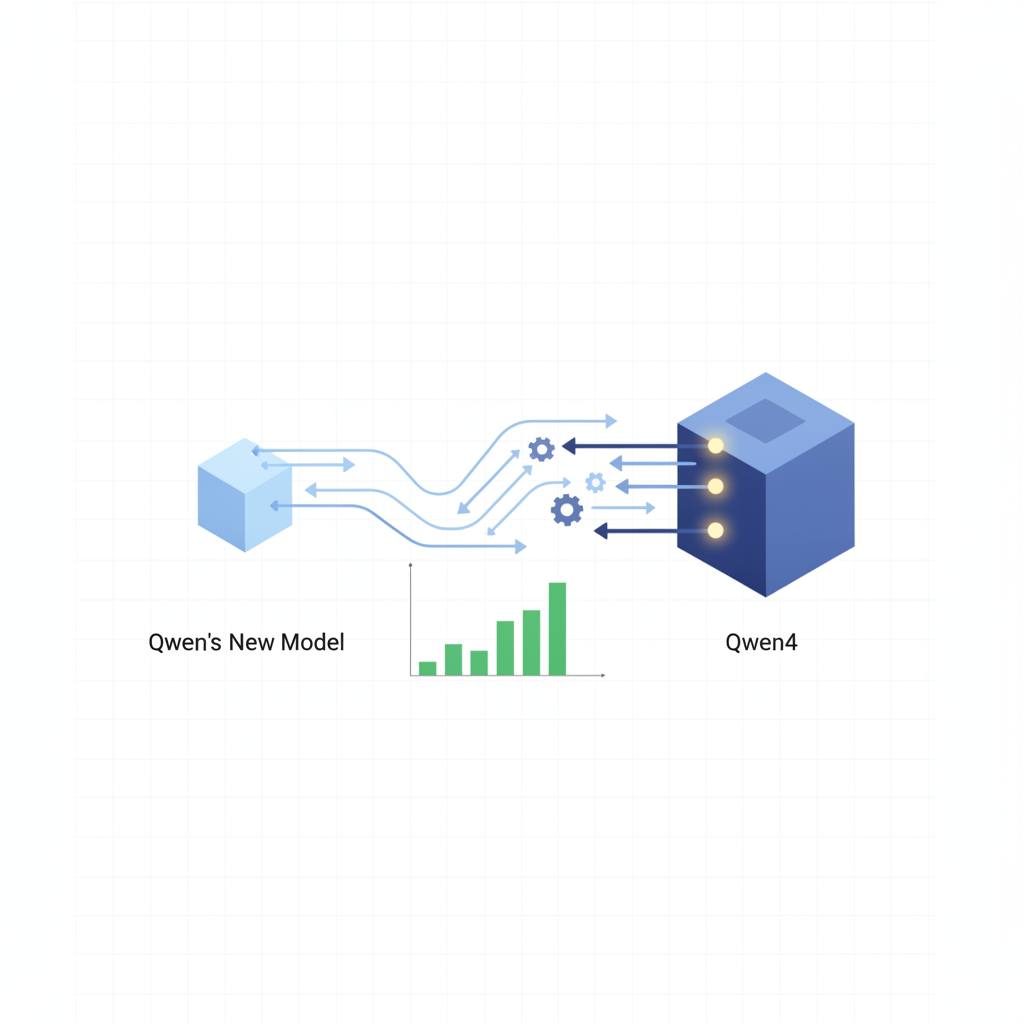
Qwen3.8-Flash-Next hints at a big change for Qwen4, focusing on making powerful AI models more affordable to run thanks to its efficient architecture, challenging the idea that bigger models always mean higher costs.
Get ready, because Qwen's upcoming AI models might just give us powerful capabilities without the usual high costs. We've been looking at Qwen3.8-Flash-Next, and it offers some real clues about where Qwen4 is headed, moving past all the rumors. What this means for you is potentially stronger AI tools that are more efficient to use.
The coolest part that caught our eye isn't about how massive the model is overall. It's about how smart it is with its resources. Qwen3.8-Flash-Next uses something called a 'Mixture-of-Experts' (MoE) architecture. Think of it like a huge team of specialists; for any given task, only a small, relevant group of them is actively working. This model might have around 125 billion total parameters, but only about 6 billion are active when processing each piece of information. This totally changes the old idea that 'bigger models always mean more expensive models.' With MoE, Qwen can have a much larger capacity pool and only activate a small portion for each task.
For developers and anyone building with AI, this is fantastic news. It could mean you get much stronger reasoning, better coding support, and improved tool use from an AI, all without paying the full operational cost you'd expect from a large, traditional model. That's the key thing to watch when Qwen4 eventually arrives: not just a huge number of total parameters, but how much of that power is actually active during real-world tasks and how efficient it truly is outside of perfect lab conditions.
Qwen3.8-Flash-Next also points towards a big focus on handling long conversations and lots of data. The model supports a really large context window, potentially reaching up to a million tokens. But here's the kicker: the maximum number isn't the whole story anymore. Many models brag about massive context windows. The real question is whether they remain truly useful when you actually fill them up. For practical applications, we want to know if it can reliably handle a huge codebase, hundreds of thousands of words of documentation, long histories from AI agents, or mixed text and visual information. We'll be looking at how well it retrieves information, how fast it responds, and how much it costs to run as that context grows. A model that accepts a million tokens but can't find the important bits isn't much help, is it?
The coolest part that caught our eye isn't about how massive the model is overall. It's about how smart it is with its resources. Qwen3.8-Flash-Next uses something called a 'Mixture-of-Experts' (MoE) architecture. Think of it like a huge team of specialists; for any given task, only a small, relevant group of them is actively working. This model might have around 125 billion total parameters, but only about 6 billion are active when processing each piece of information. This totally changes the old idea that 'bigger models always mean more expensive models.' With MoE, Qwen can have a much larger capacity pool and only activate a small portion for each task.
For developers and anyone building with AI, this is fantastic news. It could mean you get much stronger reasoning, better coding support, and improved tool use from an AI, all without paying the full operational cost you'd expect from a large, traditional model. That's the key thing to watch when Qwen4 eventually arrives: not just a huge number of total parameters, but how much of that power is actually active during real-world tasks and how efficient it truly is outside of perfect lab conditions.
Qwen3.8-Flash-Next also points towards a big focus on handling long conversations and lots of data. The model supports a really large context window, potentially reaching up to a million tokens. But here's the kicker: the maximum number isn't the whole story anymore. Many models brag about massive context windows. The real question is whether they remain truly useful when you actually fill them up. For practical applications, we want to know if it can reliably handle a huge codebase, hundreds of thousands of words of documentation, long histories from AI agents, or mixed text and visual information. We'll be looking at how well it retrieves information, how fast it responds, and how much it costs to run as that context grows. A model that accepts a million tokens but can't find the important bits isn't much help, is it?