While often believed to be inherently faster, the Virtual DOM's true strength lies not in raw speed over the Real DOM for every change, but in managing complex, frequent updates efficiently, making dynamic web applications smoother and easier to develop.
You've probably heard the claim: «React is fast because it uses a Virtual DOM.» At first glance, this sounds logical. Browsers render web pages using something called the 'Real DOM' (Document Object Model), which is often described as «expensive» or «slow» to update. So, does this mean the Virtual DOM is inherently faster? The truth is, it's a bit more nuanced than that.
Imagine you're building a house. The Real DOM is like the actual architectural blueprint of the house that the builder (your web browser) uses to construct and display it. When you load a webpage, the browser converts the HTML code into this tree-like blueprint, the Real DOM, which represents every part of your page (a heading, a button, an image). Any change to your webpage requires modifying this real blueprint directly. If you know exactly which wall you want to change, updating it directly on the real blueprint can be very fast and efficient.
The challenge arises when you need to make many small, frequent changes in different parts of the house. Imagine you're changing the color of every room, then its furniture, then the size of every window. Each time, the builder would have to re-evaluate a large part of the blueprint, potentially requiring significant portions of the house to be redrawn. This can become very slow and resource-intensive, especially in modern web applications where the user interface changes constantly.
This is where the Virtual DOM comes in: Instead of modifying the actual architectural blueprint (Real DOM) directly every single time, imagine you have a draft or a fictitious copy of this blueprint (the Virtual DOM). When you want to make changes, you don't apply them to the real blueprint. Instead, you make all your modifications to this virtual draft first. You change the colors, furniture, and windows on your draft.
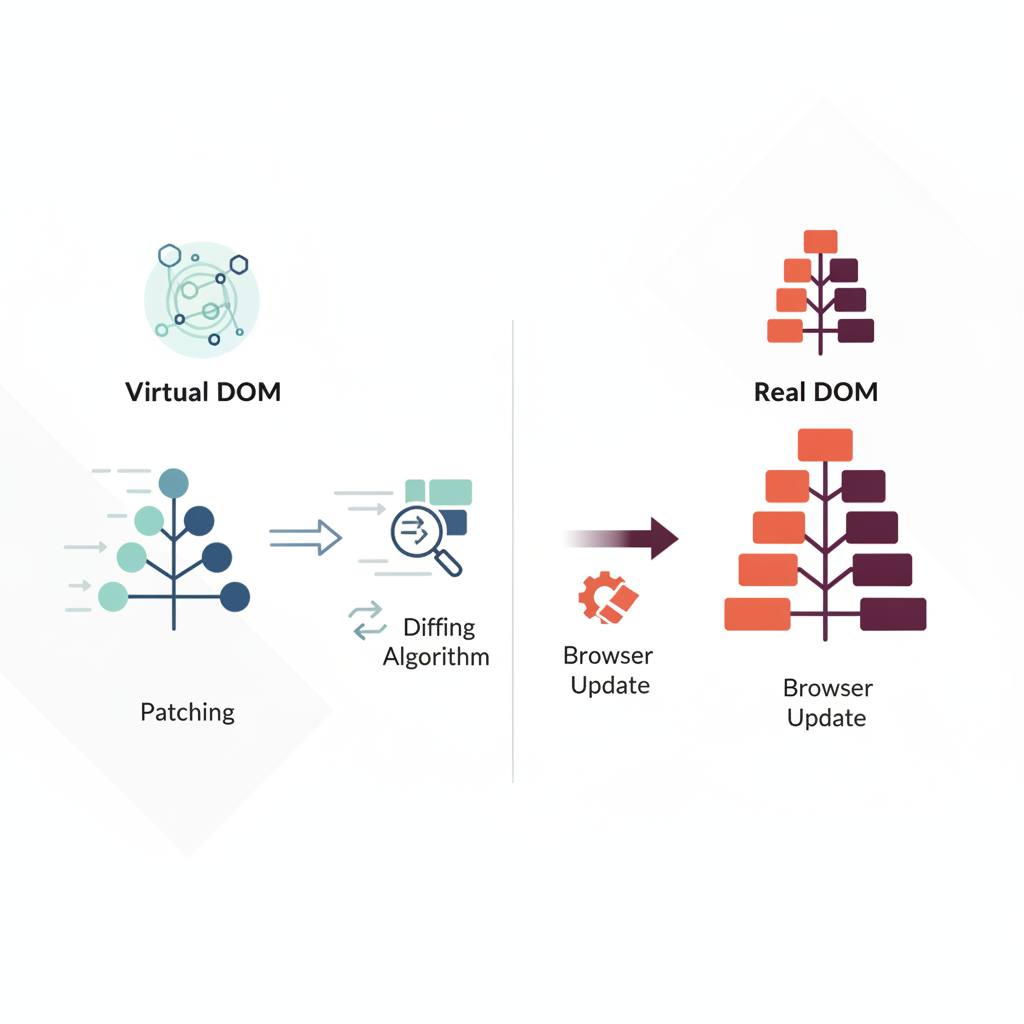
Once you've finished all your changes on the virtual draft, the Virtual DOM system compares this new draft with the old one, identifying *only* the essential differences. Then, it instructs the builder (the browser) about the *minimal, necessary* changes that need to be applied to the real blueprint (Real DOM). This is like telling the builder: 'Just change the color of room #3 and add a small window here.' Instead of rebuilding large sections, the browser updates only the required elements.
The Virtual DOM isn't inherently faster for every individual change. Instead, it's a tool that makes the process of updating *complex and frequent* user interfaces much more efficient and smoother. It reduces the number of times the browser has to redraw the entire page, making web applications more responsive and allowing developers to build dynamic UIs without constantly worrying about performance issues from frequent Real DOM updates. It provides a better experience for both users and developers.
Imagine you're building a house. The Real DOM is like the actual architectural blueprint of the house that the builder (your web browser) uses to construct and display it. When you load a webpage, the browser converts the HTML code into this tree-like blueprint, the Real DOM, which represents every part of your page (a heading, a button, an image). Any change to your webpage requires modifying this real blueprint directly. If you know exactly which wall you want to change, updating it directly on the real blueprint can be very fast and efficient.
The challenge arises when you need to make many small, frequent changes in different parts of the house. Imagine you're changing the color of every room, then its furniture, then the size of every window. Each time, the builder would have to re-evaluate a large part of the blueprint, potentially requiring significant portions of the house to be redrawn. This can become very slow and resource-intensive, especially in modern web applications where the user interface changes constantly.
This is where the Virtual DOM comes in: Instead of modifying the actual architectural blueprint (Real DOM) directly every single time, imagine you have a draft or a fictitious copy of this blueprint (the Virtual DOM). When you want to make changes, you don't apply them to the real blueprint. Instead, you make all your modifications to this virtual draft first. You change the colors, furniture, and windows on your draft.
Once you've finished all your changes on the virtual draft, the Virtual DOM system compares this new draft with the old one, identifying *only* the essential differences. Then, it instructs the builder (the browser) about the *minimal, necessary* changes that need to be applied to the real blueprint (Real DOM). This is like telling the builder: 'Just change the color of room #3 and add a small window here.' Instead of rebuilding large sections, the browser updates only the required elements.
The Virtual DOM isn't inherently faster for every individual change. Instead, it's a tool that makes the process of updating *complex and frequent* user interfaces much more efficient and smoother. It reduces the number of times the browser has to redraw the entire page, making web applications more responsive and allowing developers to build dynamic UIs without constantly worrying about performance issues from frequent Real DOM updates. It provides a better experience for both users and developers.