NVIDIA's new B300 Blackwell Ultra GPU prioritizes increased memory capacity and specific speed boosts for AI training over raw compute gains. It's ideal for memory-intensive tasks or NVFP4 training, while the B200 remains a cost-effective choice for most other workloads.
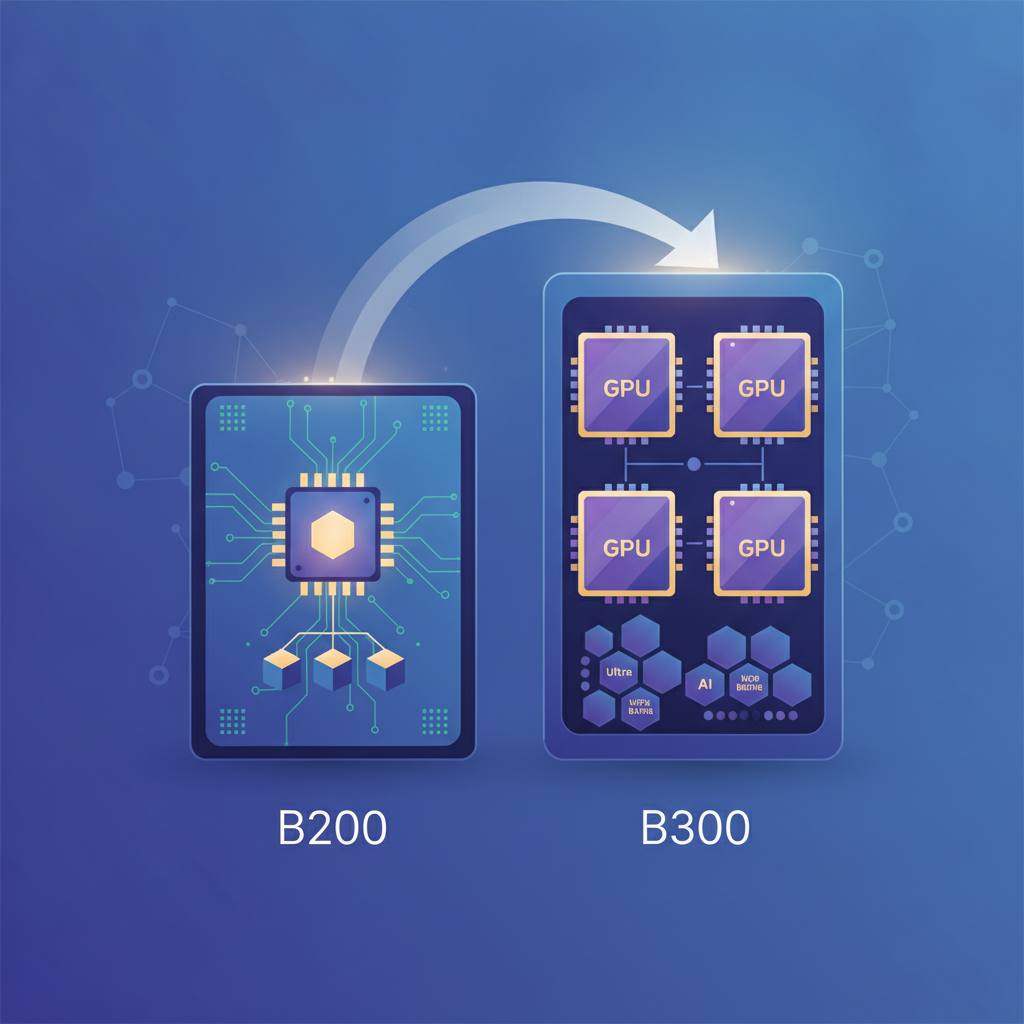
Thinking about NVIDIA's latest Blackwell Ultra B300 GPU for your AI training projects? Here's the deal: the biggest upgrade from the B200 isn't raw speed for common tasks like BF16 or FP8 training, but a significant boost in memory. The B300 comes with a whopping 288 GB of HBM3e memory per GPU, a solid 60% increase compared to the B200's 180 GB. This extra memory is crucial, giving you more room for model weights, optimizer states, and activations, potentially allowing for larger models or bigger batch sizes on a single GPU.
What does this mean for your wallet? The B300 is listed at $6.943 per hour, while the B200 is $5.50 per hour. To make the B300 more cost-effective, your training job needs to finish at least 1.26 times faster. This happens when the extra memory saves you from needing a second GPU node or offloading data to the CPU, which can slow things down considerably.
Beyond memory, the B300 also shines in specific areas. It offers 1.5 times faster performance if you're training using NVFP4, and significantly quicker «attention math» (useful for tasks involving transformers). It also doubles the networking speed for 8-GPU boards, which is great for large multi-node training jobs. However, if your work relies heavily on BF16 or FP8 dense compute, you won't see a speed difference, as both GPUs offer the same throughput there. Memory bandwidth and NVLink speeds within a node also remain unchanged. Interestingly, the B300 isn't suited for FP64 science codes, where it actually performs worse. It also consumes more power, up to 1,400W compared to the B200's 1,200W.
So, when should you pick the B300? Go for it if your training job is memory-hungry, where that extra 108 GB prevents bottlenecks. It's also a clear winner if you're specifically training in NVFP4. For everything else – especially if your job fits comfortably within the B200's memory and doesn't use NVFP4 heavily – the B200 remains the more economical and practical choice. Think carefully about your specific workload before you decide!
What does this mean for your wallet? The B300 is listed at $6.943 per hour, while the B200 is $5.50 per hour. To make the B300 more cost-effective, your training job needs to finish at least 1.26 times faster. This happens when the extra memory saves you from needing a second GPU node or offloading data to the CPU, which can slow things down considerably.
Beyond memory, the B300 also shines in specific areas. It offers 1.5 times faster performance if you're training using NVFP4, and significantly quicker «attention math» (useful for tasks involving transformers). It also doubles the networking speed for 8-GPU boards, which is great for large multi-node training jobs. However, if your work relies heavily on BF16 or FP8 dense compute, you won't see a speed difference, as both GPUs offer the same throughput there. Memory bandwidth and NVLink speeds within a node also remain unchanged. Interestingly, the B300 isn't suited for FP64 science codes, where it actually performs worse. It also consumes more power, up to 1,400W compared to the B200's 1,200W.
So, when should you pick the B300? Go for it if your training job is memory-hungry, where that extra 108 GB prevents bottlenecks. It's also a clear winner if you're specifically training in NVFP4. For everything else – especially if your job fits comfortably within the B200's memory and doesn't use NVFP4 heavily – the B200 remains the more economical and practical choice. Think carefully about your specific workload before you decide!