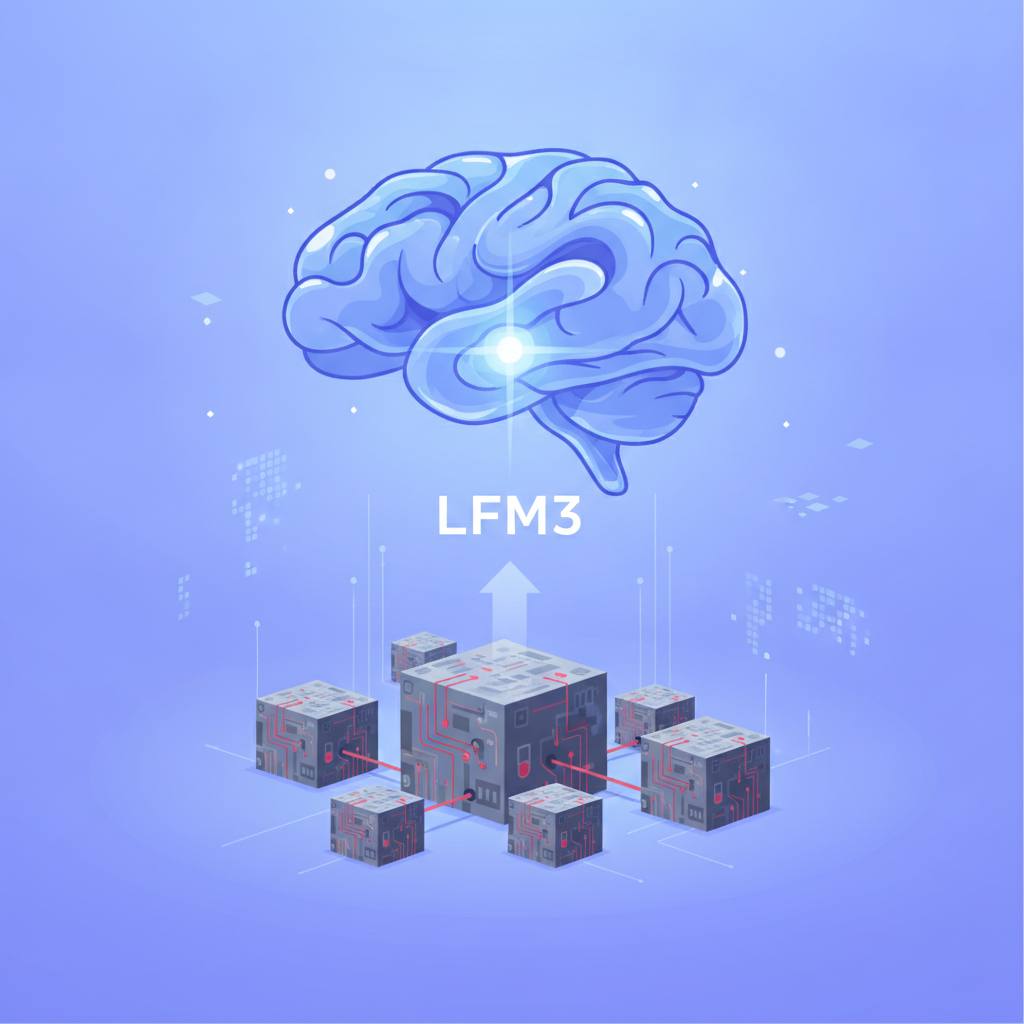
Liquid AI has unveiled LFM3, a new series of incredibly efficient, open-weight AI models. The standout LFM3-1.7B model, at just 1GB, is proving it can outperform much larger models on key AI agent tasks, making local AI more powerful than ever.
Imagine an AI model so small it fits comfortably on your device, yet powerful enough to tackle tasks usually handled by much larger, more demanding systems. That's precisely what Liquid AI is promising with its new LFM3 family of models, and what this means for you is potentially faster, more private, and more accessible AI right on your local machines.
At the heart of this new offering is LFM3-1.7B, a 1.7-billion-parameter model that's incredibly light. When compressed to 4-bit precision, it takes up only about 1 gigabyte of space. Despite its tiny footprint, it boasts an impressive 256,000-token context window – that's a lot of information it can keep track of at once! This model is open-weight, meaning developers can download and use it freely.
Liquid AI isn't just making claims; they're showing results. LFM3-1.7B has been benchmarked against bigger competitors like Qwen 3.5 9B and actually beats it on crucial 'agent tasks' like browsing the web (WebArena), automating workflows (AutomationBench), and making function calls. This is a big deal because these are the actions AI agents often need to perform to be truly useful. It's also remarkably memory-efficient, using only 1.6 GB of KV cache for 128,000 tokens of context, compared to 4.3 GB for Qwen 3.5 4B, which is a massive saving for local deployment.
Of course, it's not perfect everywhere. LFM3-1.7B does lose out to larger models when it comes to complex coding (like on SWE-bench) or general knowledge tasks (like GPQA). Its strength lies in specialized, agent-focused applications.
The secret behind its efficiency? A clever 'tri-hybrid' architecture. Instead of relying solely on the memory-hungry attention layers found in pure transformers, LFM3 mixes 13 convolution layers, 5 sliding-window attention layers, and 6 global attention layers across its 24 layers. This combination helps it process information effectively without hogging resources. The LFM3 family isn't just one model; it includes six versions, all built around the LFM3-1.7B-Base, including models for text, vision, audio, and even ‘Omni’ models that combine multiple input types, plus two decision-making specific models. The best part? Liquid AI says you can fine-tune any of these models using just a single GPU.
So, for developers and users who need powerful AI agents running locally, perhaps on a laptop or a dedicated device, LFM3 offers a compelling solution. It means more accessible AI tools, enhanced privacy by keeping data on your own machine, and the ability to deploy sophisticated AI without needing massive cloud infrastructure. It's a significant step towards bringing advanced AI capabilities closer to everyday use.
At the heart of this new offering is LFM3-1.7B, a 1.7-billion-parameter model that's incredibly light. When compressed to 4-bit precision, it takes up only about 1 gigabyte of space. Despite its tiny footprint, it boasts an impressive 256,000-token context window – that's a lot of information it can keep track of at once! This model is open-weight, meaning developers can download and use it freely.
Liquid AI isn't just making claims; they're showing results. LFM3-1.7B has been benchmarked against bigger competitors like Qwen 3.5 9B and actually beats it on crucial 'agent tasks' like browsing the web (WebArena), automating workflows (AutomationBench), and making function calls. This is a big deal because these are the actions AI agents often need to perform to be truly useful. It's also remarkably memory-efficient, using only 1.6 GB of KV cache for 128,000 tokens of context, compared to 4.3 GB for Qwen 3.5 4B, which is a massive saving for local deployment.
Of course, it's not perfect everywhere. LFM3-1.7B does lose out to larger models when it comes to complex coding (like on SWE-bench) or general knowledge tasks (like GPQA). Its strength lies in specialized, agent-focused applications.
The secret behind its efficiency? A clever 'tri-hybrid' architecture. Instead of relying solely on the memory-hungry attention layers found in pure transformers, LFM3 mixes 13 convolution layers, 5 sliding-window attention layers, and 6 global attention layers across its 24 layers. This combination helps it process information effectively without hogging resources. The LFM3 family isn't just one model; it includes six versions, all built around the LFM3-1.7B-Base, including models for text, vision, audio, and even ‘Omni’ models that combine multiple input types, plus two decision-making specific models. The best part? Liquid AI says you can fine-tune any of these models using just a single GPU.
So, for developers and users who need powerful AI agents running locally, perhaps on a laptop or a dedicated device, LFM3 offers a compelling solution. It means more accessible AI tools, enhanced privacy by keeping data on your own machine, and the ability to deploy sophisticated AI without needing massive cloud infrastructure. It's a significant step towards bringing advanced AI capabilities closer to everyday use.