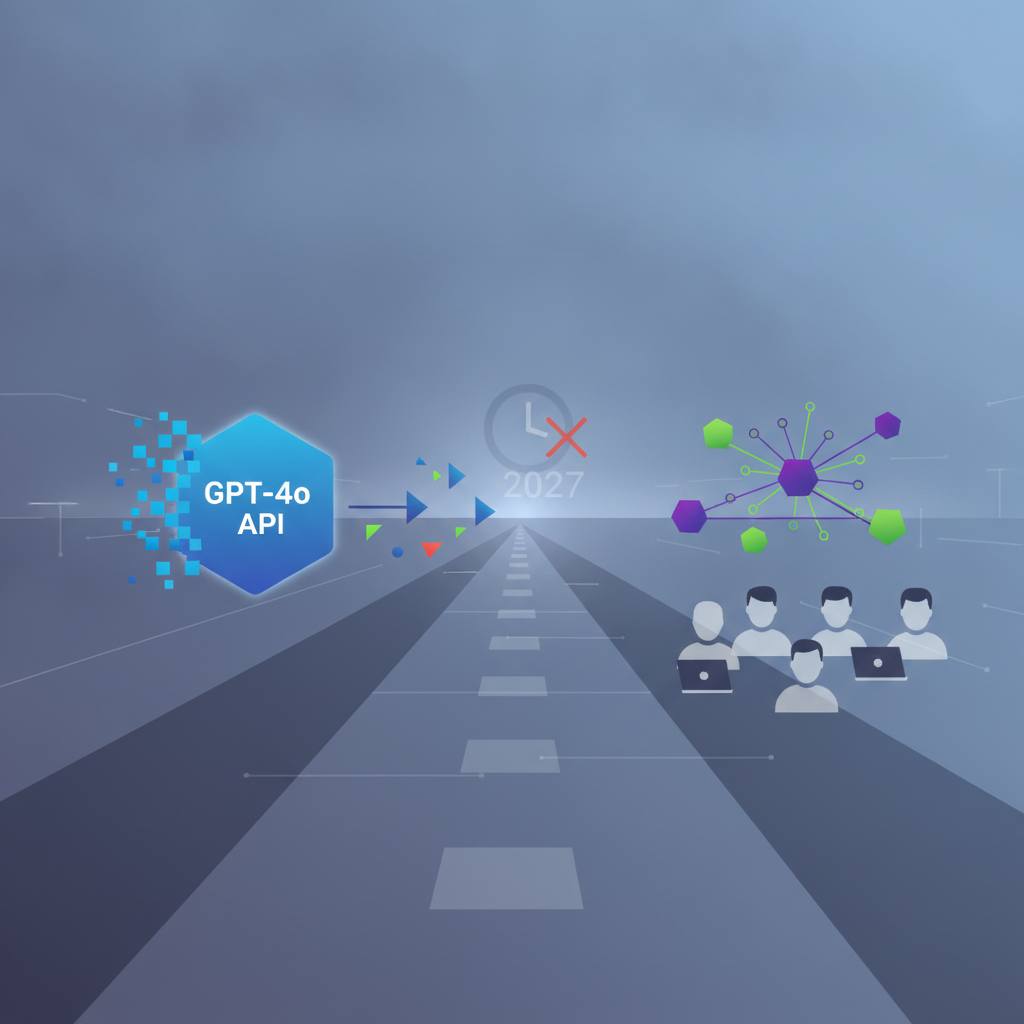
OpenAI is retiring several GPT models, including GPT-4o and its variants, from its API in phases starting October 2026, with a final shutdown by January 2027. Developers must update their applications to newer models to avoid service interruption.
To all developers relying on GPT models for their applications, we have incredibly important news: OpenAI is retiring GPT-4o and several other models from its API soon. This means if your products or services are calling these models, you need to pay attention and act quickly to avoid any service disruption.
Let’s break down what this means for you. The good news is that regular ChatGPT users are completely unaffected; they were already shifted to the GPT-5 family in February 2026. But for developers, the clock is ticking. There are several waves of model retirements, and the first critical date is October 23, 2026. On this day, the original May 2024 snapshot of GPT-4o (identified as gpt-4o-2024-05-13) will shut down, alongside GPT-4 Turbo, GPT-4, GPT-3.5 Turbo, and several other models like o1, o3-mini, o4-mini, and gpt-image-1. The recommended replacement for these models is the new GPT-5.6-series.
The next and more comprehensive wave will hit on January 14, 2027. On this date, the newer August and November 2024 snapshots of GPT-4o, GPT-4o mini, GPT-4.1, and GPT-4.1 mini will leave the API. Here, everyone should transition to gpt-6-luna, which OpenAI describes as the smallest and cheapest model in the GPT-6 family. Even custom fine-tunes of these models will follow the same schedule.
It’s absolutely critical to confirm the exact model string your code uses, not just the general family name. This is because the May 2024 snapshot of GPT-4o retires in October 2026, while the August and November 2024 snapshots survive until January 2027. If you are using voice features, there are two more waves: audio and realtime variants shut down on January 20, 2027, and transcription variants (including Whisper-1) shut down on February 26, 2027.
Unfortunately, OpenAI only gave developers roughly three months' notice for the most recent retirements, which is shorter than their usual promised six months. So, don't delay! Start checking OpenAI's documentation and their deprecations page for the latest information and to identify the necessary steps to migrate your applications to the new models to avoid any surprises.
Let’s break down what this means for you. The good news is that regular ChatGPT users are completely unaffected; they were already shifted to the GPT-5 family in February 2026. But for developers, the clock is ticking. There are several waves of model retirements, and the first critical date is October 23, 2026. On this day, the original May 2024 snapshot of GPT-4o (identified as gpt-4o-2024-05-13) will shut down, alongside GPT-4 Turbo, GPT-4, GPT-3.5 Turbo, and several other models like o1, o3-mini, o4-mini, and gpt-image-1. The recommended replacement for these models is the new GPT-5.6-series.
The next and more comprehensive wave will hit on January 14, 2027. On this date, the newer August and November 2024 snapshots of GPT-4o, GPT-4o mini, GPT-4.1, and GPT-4.1 mini will leave the API. Here, everyone should transition to gpt-6-luna, which OpenAI describes as the smallest and cheapest model in the GPT-6 family. Even custom fine-tunes of these models will follow the same schedule.
It’s absolutely critical to confirm the exact model string your code uses, not just the general family name. This is because the May 2024 snapshot of GPT-4o retires in October 2026, while the August and November 2024 snapshots survive until January 2027. If you are using voice features, there are two more waves: audio and realtime variants shut down on January 20, 2027, and transcription variants (including Whisper-1) shut down on February 26, 2027.
Unfortunately, OpenAI only gave developers roughly three months' notice for the most recent retirements, which is shorter than their usual promised six months. So, don't delay! Start checking OpenAI's documentation and their deprecations page for the latest information and to identify the necessary steps to migrate your applications to the new models to avoid any surprises.