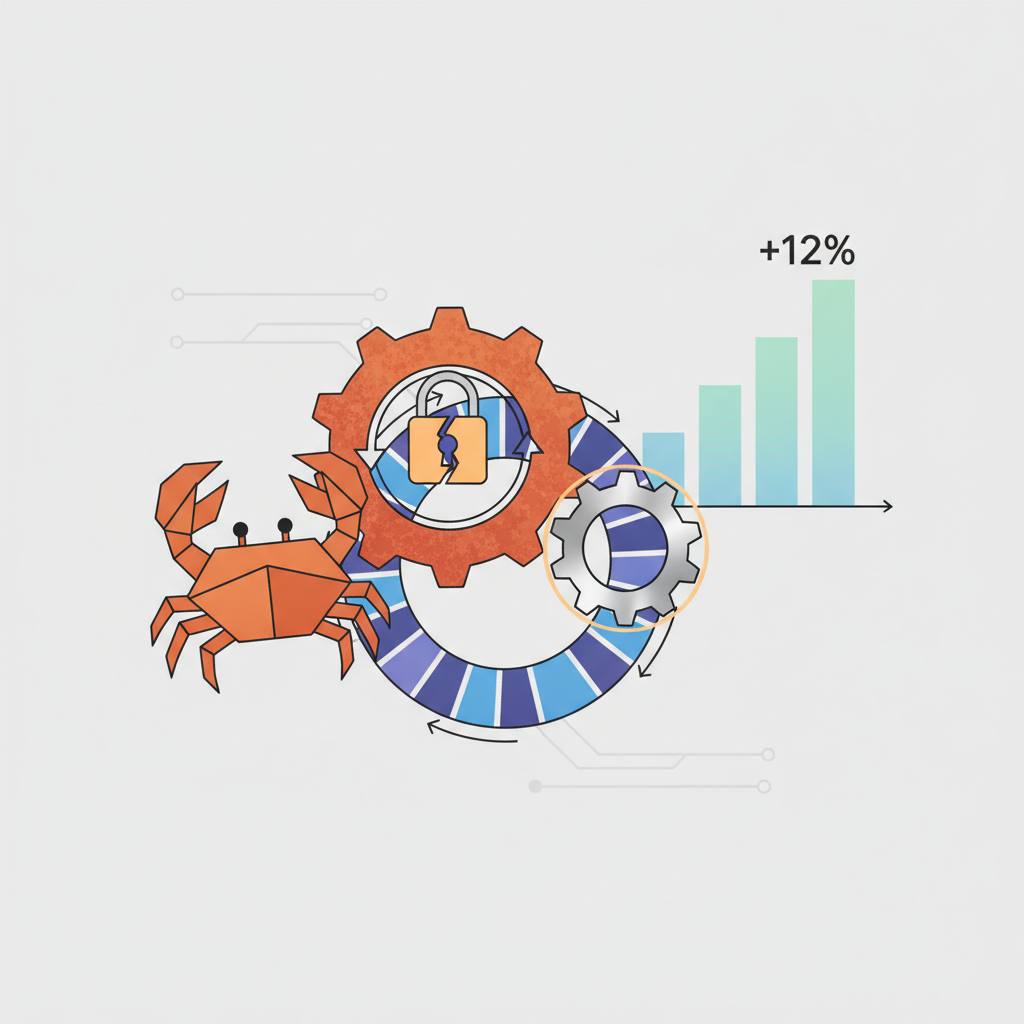
A tech team discovered how a lock-free ring buffer can dramatically outperform traditional mutex queues, significantly boosting the speed and efficiency of Rust services. This means applications can deliver faster responses and waste less CPU power.
Ever wonder how high-performance services manage to handle millions of requests without breaking a sweat? Well, a tech team just found a clever way to make a Rust service handling 200,000 requests per second even faster and smoother. What this means for you is a quicker, more reliable tech experience in your daily life.
Previously, this service used a common method called a 'Mutex queue' to organize tasks between its different parts. Imagine a Mutex as a single gate everyone has to pass through one at a time. When too many people (requests) show up, that gate becomes a bottleneck, leading to long queues and delays. In their case, this Mutex consumed about 12% of the total CPU power, time that wasn't spent on actual data processing! It was just managing turns and waiting. It also caused issues like 'lock-starvation' and 'L1 cache-line eviction,' technical terms that basically mean the processor had to do a lot of unnecessary extra work, reducing its efficiency and causing delays.
To overcome this hurdle, they replaced the Mutex with something called a 'Lock-Free Ring Buffer.' Think of this as a multi-lane roundabout where vehicles (data) can enter and exit without needing to stop at a central traffic light. This solution uses smart techniques called 'atomic indices' to allow different parts of the program to work on the buffer concurrently without crashing into each other.
The result was impressive: the bottleneck disappeared, and the service became much more efficient. This kind of design significantly reduces 'tail latency'—the time it takes for some of the slower requests to process—and eliminates those sudden spikes in response time. By using atomic indices and the clever fixed-size buffer design, they effectively avoided the 'cache-line ping-pong' problem, meaning the processor can focus more intently on real tasks. For you, this means the technologies you rely on daily, from phone apps to cloud services, can become quicker, more responsive, and more stable thanks to engineering innovations like this. It's a big step towards pushing software performance to its absolute limits.
Previously, this service used a common method called a 'Mutex queue' to organize tasks between its different parts. Imagine a Mutex as a single gate everyone has to pass through one at a time. When too many people (requests) show up, that gate becomes a bottleneck, leading to long queues and delays. In their case, this Mutex consumed about 12% of the total CPU power, time that wasn't spent on actual data processing! It was just managing turns and waiting. It also caused issues like 'lock-starvation' and 'L1 cache-line eviction,' technical terms that basically mean the processor had to do a lot of unnecessary extra work, reducing its efficiency and causing delays.
To overcome this hurdle, they replaced the Mutex with something called a 'Lock-Free Ring Buffer.' Think of this as a multi-lane roundabout where vehicles (data) can enter and exit without needing to stop at a central traffic light. This solution uses smart techniques called 'atomic indices' to allow different parts of the program to work on the buffer concurrently without crashing into each other.
The result was impressive: the bottleneck disappeared, and the service became much more efficient. This kind of design significantly reduces 'tail latency'—the time it takes for some of the slower requests to process—and eliminates those sudden spikes in response time. By using atomic indices and the clever fixed-size buffer design, they effectively avoided the 'cache-line ping-pong' problem, meaning the processor can focus more intently on real tasks. For you, this means the technologies you rely on daily, from phone apps to cloud services, can become quicker, more responsive, and more stable thanks to engineering innovations like this. It's a big step towards pushing software performance to its absolute limits.