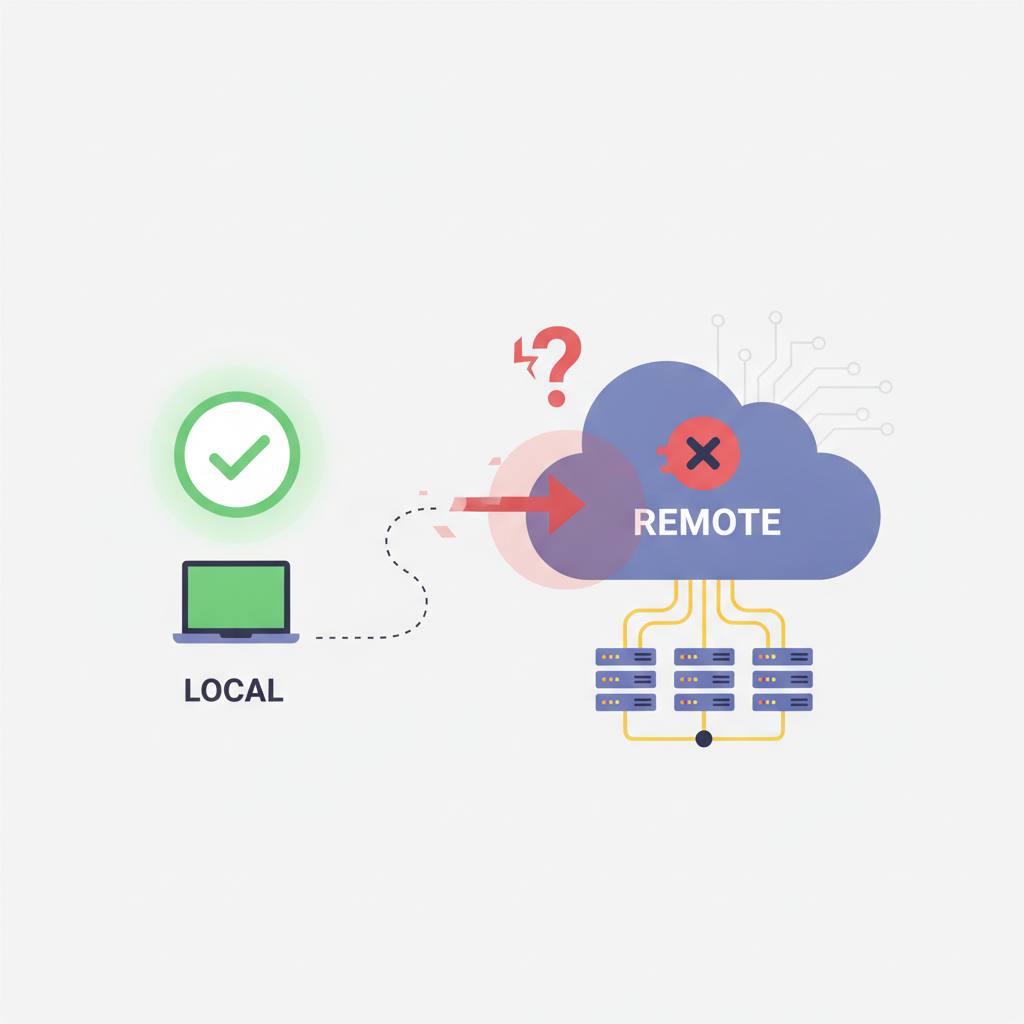
Have you ever seen a code test pass on your laptop only to fail on a remote server? Often, this happens due to subtle differences in local environment settings, and the advice is to document these settings first before blaming the code itself.
Hello WondTech friends! Have you ever experienced that head-scratching mystery where your code runs perfectly on your laptop, but then fails strangely when you deploy it to a 'clean' remote server? If so, you're not alone! This surprise happens frequently, even when the files themselves appear to be completely identical. The issue here isn't necessarily with the bytes of the file, but rather with how they are read and opened by the system underneath.
To solve this puzzle, programming experts suggest adopting a critical methodology: thoroughly record and document the server's local environment *before* jumping to conclusions about code errors. The idea is to spend 48 hours capturing all the details of the environment where the file is opened, rather than simply inventing a root cause in the first hour. A clean job environment on a server often has a 'thinner' locale than the shell you keep open all day on your personal machine, and this can lead to unexpected issues.
What does this mean for you as a developer? It means that before you start debugging your code, you should check some fundamental environment details. For instance, functions like 'Path.read_text()' and 'text-mode open()' in Python follow the process encoding if you don't explicitly set the encoding argument. If the default preferred encoding on the server is ASCII, but your fixture file is UTF-8, you might encounter a 'UnicodeDecodeError' even if a byte-level diff shows no difference.
Therefore, it's highly recommended to print the environment's 'LANG' variable and use the 'locale.getpreferredencoding()' function to discover the preferred encoding. More importantly, check the value of 'sys.flags.utf8_mode' to confirm whether UTF-8 mode is truly enabled in the interpreter used on the server. This setting can differ between your laptop and a fresh server image, and this very disagreement is the failure you need to document. Remember, freezing the environment and documenting it first will allow any later explanation to earn its place in your notes, rather than just guessing or relying on AI models without providing them the necessary environmental context.
To solve this puzzle, programming experts suggest adopting a critical methodology: thoroughly record and document the server's local environment *before* jumping to conclusions about code errors. The idea is to spend 48 hours capturing all the details of the environment where the file is opened, rather than simply inventing a root cause in the first hour. A clean job environment on a server often has a 'thinner' locale than the shell you keep open all day on your personal machine, and this can lead to unexpected issues.
What does this mean for you as a developer? It means that before you start debugging your code, you should check some fundamental environment details. For instance, functions like 'Path.read_text()' and 'text-mode open()' in Python follow the process encoding if you don't explicitly set the encoding argument. If the default preferred encoding on the server is ASCII, but your fixture file is UTF-8, you might encounter a 'UnicodeDecodeError' even if a byte-level diff shows no difference.
Therefore, it's highly recommended to print the environment's 'LANG' variable and use the 'locale.getpreferredencoding()' function to discover the preferred encoding. More importantly, check the value of 'sys.flags.utf8_mode' to confirm whether UTF-8 mode is truly enabled in the interpreter used on the server. This setting can differ between your laptop and a fresh server image, and this very disagreement is the failure you need to document. Remember, freezing the environment and documenting it first will allow any later explanation to earn its place in your notes, rather than just guessing or relying on AI models without providing them the necessary environmental context.