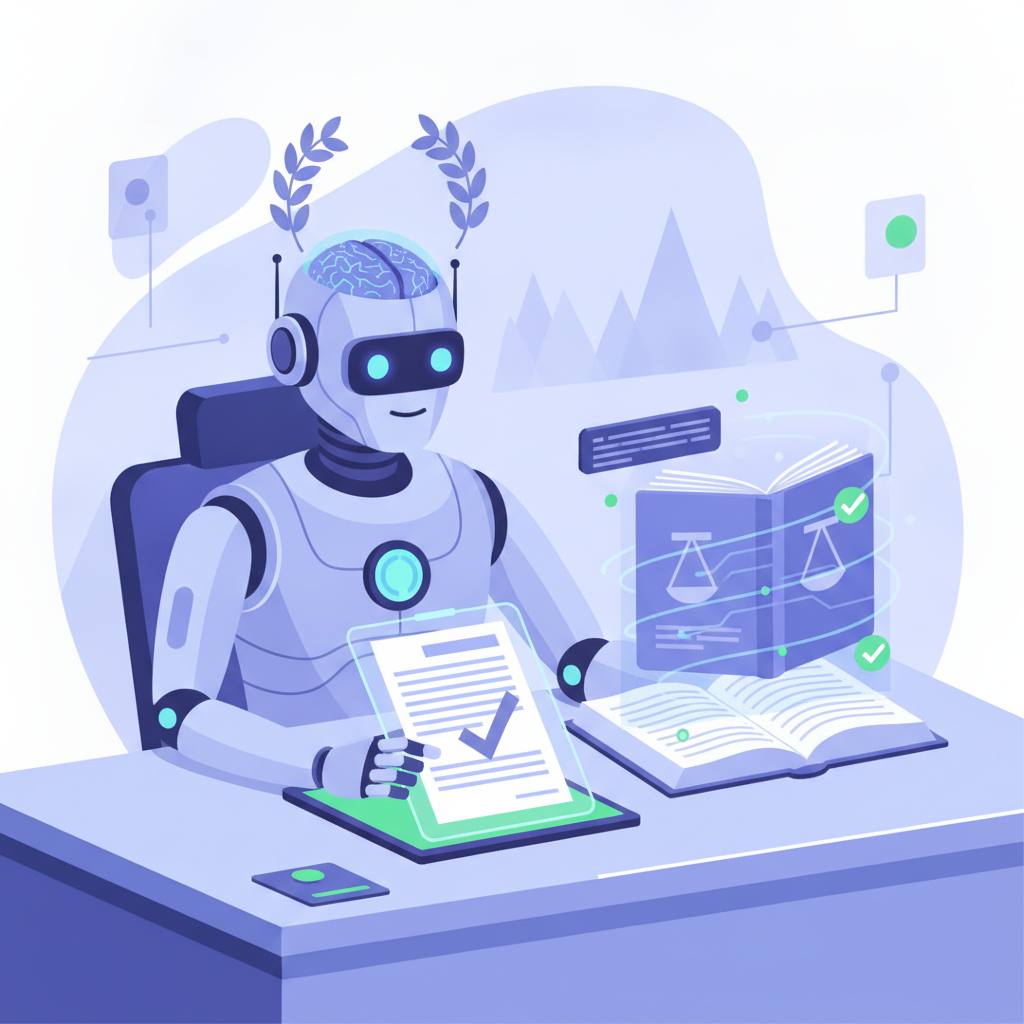
A new AI model, Darwin-180B-RSI, surprised experts by topping Swiss law exams without any specific legal training. This achievement shows how AI can use general knowledge and reasoning to tackle complex, new challenges.
Imagine a student who excels in many subjects—history, science, literature—not just by memorizing facts, but by truly understanding how information connects and by developing strong critical thinking skills. Now, imagine this student, who has never specialized in law, taking a tough law exam and performing exceptionally well. That's essentially what a new AI model, Darwin-180B-RSI, just did, topping challenging Swiss law exams (LEXam) without ever being specifically trained on legal documents or statutes.
This might seem baffling. How can an AI apply laws it's never 'learned'? The secret lies in a concept called 'generalization.' Instead of being fed only legal textbooks, models like Darwin-180B-RSI are trained on an enormous, diverse library of general text from the internet, books, articles, and more. From this vast data, the AI learns not just words, but also:
1. **Language Patterns:** How sentences are structured, what words typically mean in different contexts, and how ideas are expressed.
2. **Logical Relationships:** How cause and effect work, how arguments are constructed, and common-sense reasoning.
3. **Problem-Solving Frameworks:** How to break down complex questions, identify key facts, and arrive at a conclusion.
Think of it like learning to ride a bicycle. Once you master the general principles of balance, steering, and pedaling, you can usually hop onto a slightly different bike or even a scooter and adapt quickly, even if you've never ridden that specific type before. The AI develops a deep, flexible understanding of how information works.
When faced with a law exam that tests 'applying law to a set of facts and reasoning to a conclusion' (rather than just memorizing statutes), the AI doesn't recall specific legal clauses. Instead, it uses its advanced language comprehension to understand the scenario, its logical reasoning to connect the facts, and its pattern recognition to identify what constitutes a valid legal argument based on the *structure* of legal texts it has encountered (even if not specific laws). It's essentially applying its 'general intelligence' to a new, specialized domain. This incredible ability to generalize and apply learned reasoning skills to unfamiliar problems is a significant step forward in making AI truly intelligent and adaptable.
This might seem baffling. How can an AI apply laws it's never 'learned'? The secret lies in a concept called 'generalization.' Instead of being fed only legal textbooks, models like Darwin-180B-RSI are trained on an enormous, diverse library of general text from the internet, books, articles, and more. From this vast data, the AI learns not just words, but also:
1. **Language Patterns:** How sentences are structured, what words typically mean in different contexts, and how ideas are expressed.
2. **Logical Relationships:** How cause and effect work, how arguments are constructed, and common-sense reasoning.
3. **Problem-Solving Frameworks:** How to break down complex questions, identify key facts, and arrive at a conclusion.
Think of it like learning to ride a bicycle. Once you master the general principles of balance, steering, and pedaling, you can usually hop onto a slightly different bike or even a scooter and adapt quickly, even if you've never ridden that specific type before. The AI develops a deep, flexible understanding of how information works.
When faced with a law exam that tests 'applying law to a set of facts and reasoning to a conclusion' (rather than just memorizing statutes), the AI doesn't recall specific legal clauses. Instead, it uses its advanced language comprehension to understand the scenario, its logical reasoning to connect the facts, and its pattern recognition to identify what constitutes a valid legal argument based on the *structure* of legal texts it has encountered (even if not specific laws). It's essentially applying its 'general intelligence' to a new, specialized domain. This incredible ability to generalize and apply learned reasoning skills to unfamiliar problems is a significant step forward in making AI truly intelligent and adaptable.