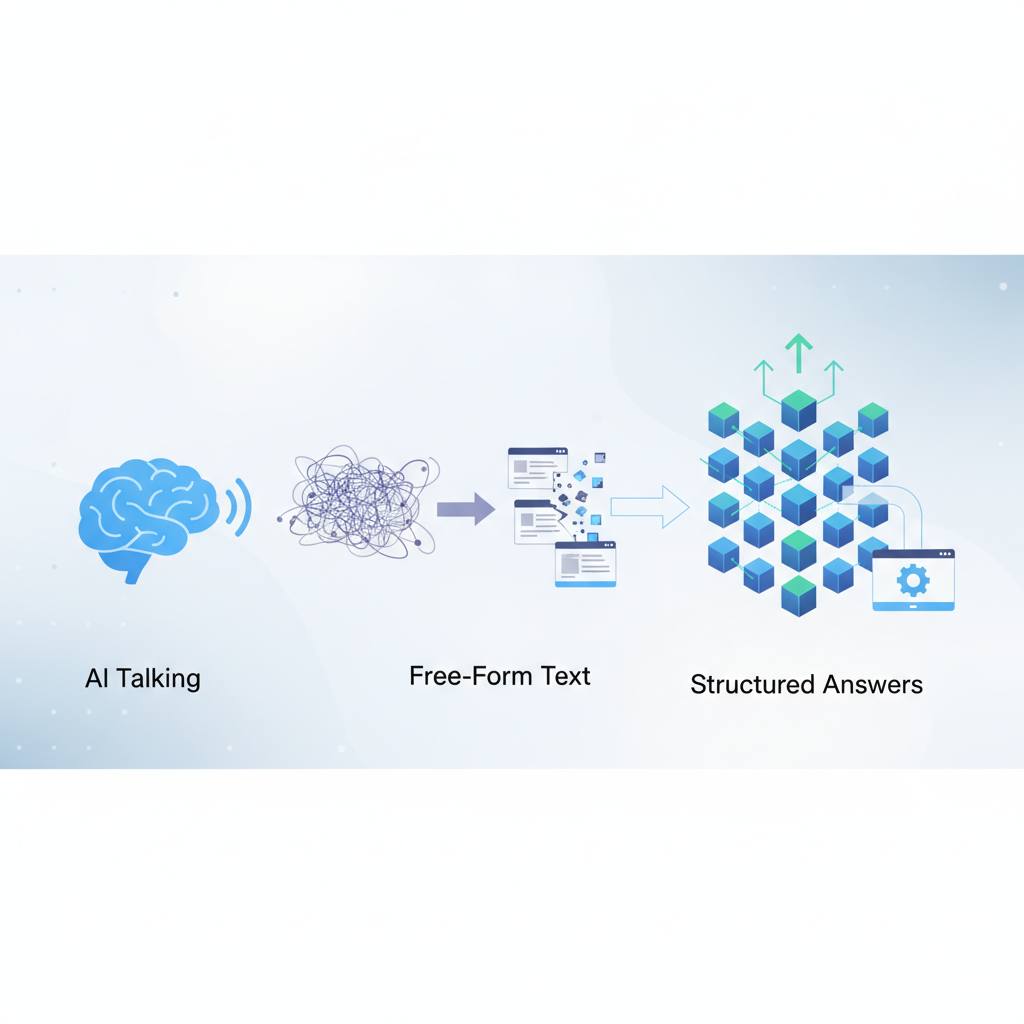
When your programs interact with AI, relying on its free-text responses for critical decisions can lead to unexpected errors. Discover why structured outputs are essential for making AI-powered applications work smartly and reliably.
Have you ever chatted with an AI program and noticed how it gives you answers in full sentences? This is great for us humans, but it can be a big problem when other programs need to understand those answers and make decisions based on them. This is the core idea behind today's news.
Imagine you ask an AI to review a request, expecting it to tell you 'approve' or 'disapprove'. If the AI responds with a sentence like: 'I believe this request looks good, but I'm not entirely sure,' how would your program know whether to proceed or not? Your program might mistakenly decide to approve it, while the AI actually meant that human review was needed.
The problem here is that programs prefer clear commands, not stories. When you rely on free-text from an AI, you are essentially creating an invisible, undesigned 'Application Programming Interface' (API). What does that mean? An API is like a restaurant menu; it tells you exactly what you can order (like 'pizza') and what you will receive (like 'Margherita pizza'). When an AI sends free text, it's like it's writing you a long letter instead of giving you a specific order from the menu.
This 'undesigned interface' has serious drawbacks:
1. **Not documented or understood:** If you slightly change your question to the AI, its textual response might change entirely, breaking the way your program tries to understand it.
2. **No error validation:** If the answer comes in a slightly different form than your program expects, it won't throw a clear error. Instead, the program will just take the wrong action.
3. **Difficult to log decisions:** You can't precisely log 'AI chose to reject' if all you have is a long paragraph of text.
The solution is simple and smart: Instead of the AI sending one single free-text output, it should send two types of outputs. First, a human-readable description, to give details and explanations. Second, a clear, specific decision for the program, such as 'Status: Approved' or 'Status: For Review'. This decision should come from a predefined list of options that your program already understands. This way, your programs can make decisions confidently and without any misunderstanding.
Imagine you ask an AI to review a request, expecting it to tell you 'approve' or 'disapprove'. If the AI responds with a sentence like: 'I believe this request looks good, but I'm not entirely sure,' how would your program know whether to proceed or not? Your program might mistakenly decide to approve it, while the AI actually meant that human review was needed.
The problem here is that programs prefer clear commands, not stories. When you rely on free-text from an AI, you are essentially creating an invisible, undesigned 'Application Programming Interface' (API). What does that mean? An API is like a restaurant menu; it tells you exactly what you can order (like 'pizza') and what you will receive (like 'Margherita pizza'). When an AI sends free text, it's like it's writing you a long letter instead of giving you a specific order from the menu.
This 'undesigned interface' has serious drawbacks:
1. **Not documented or understood:** If you slightly change your question to the AI, its textual response might change entirely, breaking the way your program tries to understand it.
2. **No error validation:** If the answer comes in a slightly different form than your program expects, it won't throw a clear error. Instead, the program will just take the wrong action.
3. **Difficult to log decisions:** You can't precisely log 'AI chose to reject' if all you have is a long paragraph of text.
The solution is simple and smart: Instead of the AI sending one single free-text output, it should send two types of outputs. First, a human-readable description, to give details and explanations. Second, a clear, specific decision for the program, such as 'Status: Approved' or 'Status: For Review'. This decision should come from a predefined list of options that your program already understands. This way, your programs can make decisions confidently and without any misunderstanding.