Traditional data access controls, like Role-Based Access Control (RBAC), are no longer sufficient on their own to protect information with the rise of AI-powered data agents.
Traditional data access controls, like Role-Based Access Control (RBAC), are encountering a significant new challenge with the rise of AI-powered enterprise data agents. This means that protecting your sensitive data now requires more than simply blocking direct access to specific tables or columns.
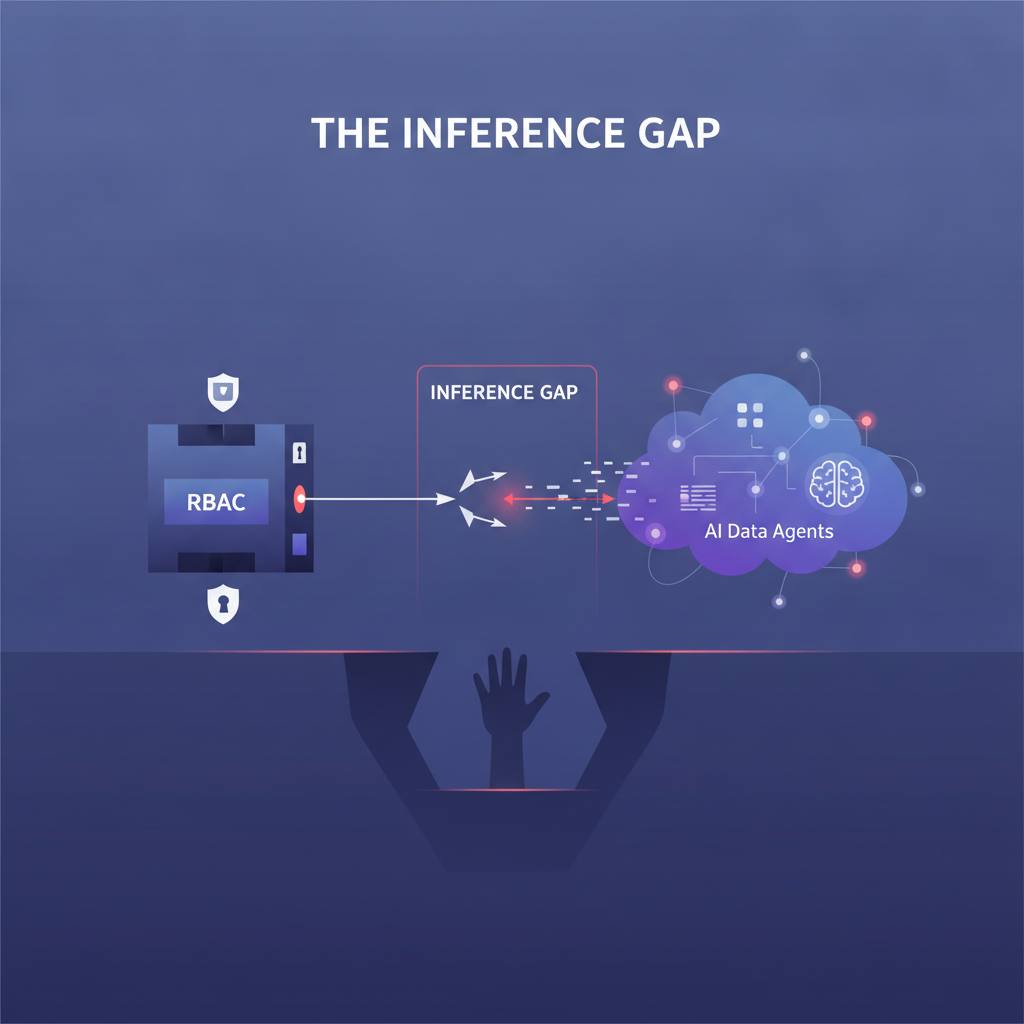
Consider this scenario: Even if you block a user from viewing an 'employee.salary' column in a database, that doesn't guarantee information protection. A smart data agent, with access to permitted data such as 'department.total_cost' and 'department.employee_count,' can easily infer an 'estimated_average_salary' for that department. In this case, no forbidden column was directly queried, but information intended to be protected might still be indirectly disclosed.
This is what we call the 'inference gap.' The issue isn't with RBAC itself; it remains fundamental and critical for defining who can access which data directly. A typical RBAC model might allow a sales manager access to customer sales orders while denying them access to payroll details. These controls should absolutely continue to be enforced robustly at the database layer.
However, AI introduces new layers of interaction between the user and the data. Instead of the traditional question, 'Can this user read this database object?', we now also need to ask: 'Is this user allowed to receive what the system can infer from those objects?' An AI agent operates through several stages, from natural language understanding to final answer generation, and each of these stages presents a potential surface for inferred information to be revealed.
Data protection in the age of AI extends beyond merely defining direct access permissions; it requires a deeper understanding of how derived information can be inferred and controlled to prevent unintended disclosure.
Consider this scenario: Even if you block a user from viewing an 'employee.salary' column in a database, that doesn't guarantee information protection. A smart data agent, with access to permitted data such as 'department.total_cost' and 'department.employee_count,' can easily infer an 'estimated_average_salary' for that department. In this case, no forbidden column was directly queried, but information intended to be protected might still be indirectly disclosed.
This is what we call the 'inference gap.' The issue isn't with RBAC itself; it remains fundamental and critical for defining who can access which data directly. A typical RBAC model might allow a sales manager access to customer sales orders while denying them access to payroll details. These controls should absolutely continue to be enforced robustly at the database layer.
However, AI introduces new layers of interaction between the user and the data. Instead of the traditional question, 'Can this user read this database object?', we now also need to ask: 'Is this user allowed to receive what the system can infer from those objects?' An AI agent operates through several stages, from natural language understanding to final answer generation, and each of these stages presents a potential surface for inferred information to be revealed.
Data protection in the age of AI extends beyond merely defining direct access permissions; it requires a deeper understanding of how derived information can be inferred and controlled to prevent unintended disclosure.