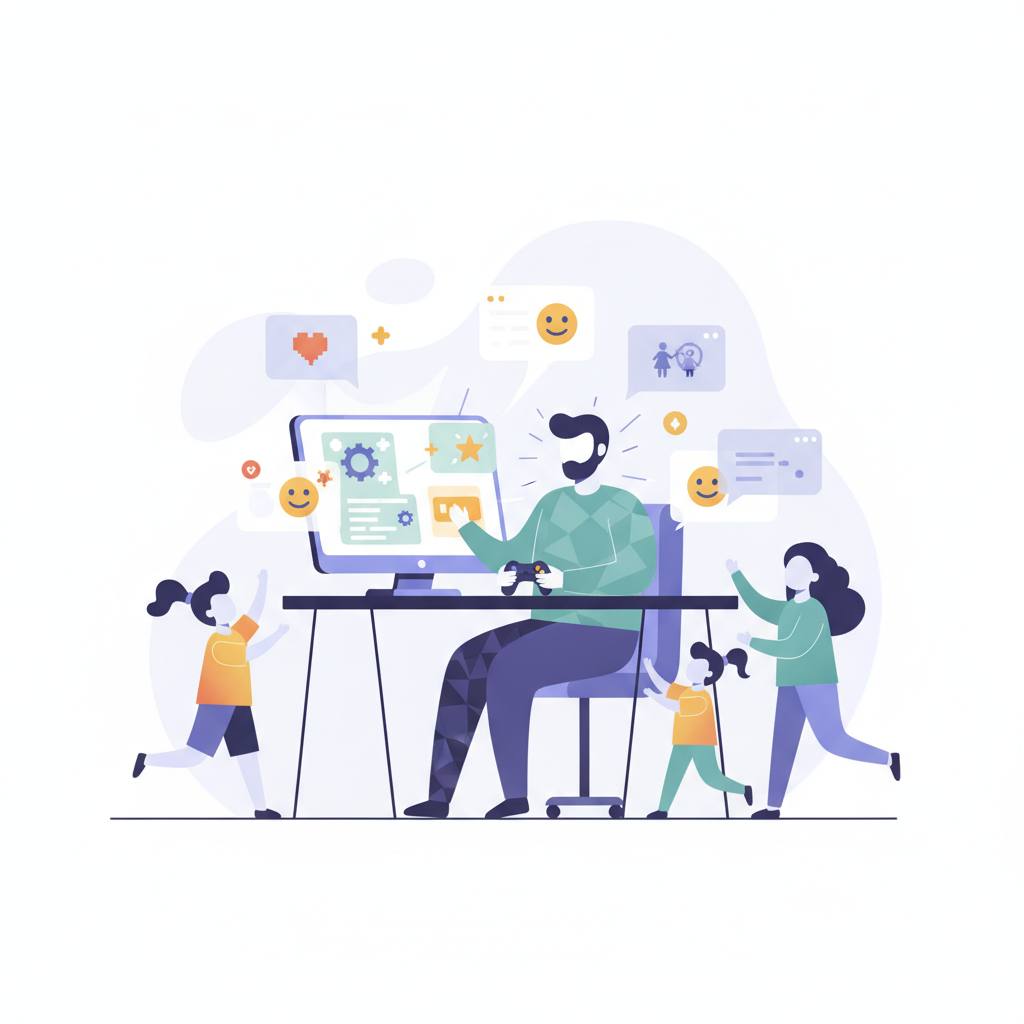
A neurodivergent engineer, facing challenges in family court due to his condition, found a unique way to be present for his children by building a chemistry game on his son's birthday. This innovative project is his response to a system not designed for neurodivergent parents.
Have you ever felt like a system just wasn't built for you? A 40-year-old autistic mechanical engineer found a powerful way to deal with exactly that, building a chemistry game called BONDING on his son's seventh birthday. What this means for you is a fascinating look at how personal challenges can spark incredible innovation.
This dedicated father, who previously maintained high-voltage systems for the Department of Defense, wasn't just building a game instead of celebrating. For him, being 'present' means something unique because his nervous system, affected by AuDHD and hypoparathyroidism, isn't always calibrated for the typical world. When his calcium levels drop, he can become cognitively impaired, making standard interactions incredibly difficult.
He’s currently navigating a tough custody battle for his two sons, S.J. (7) and W.J. (4). He found the family court system in Camden County, Georgia, focused on paperwork and neurotypical measures like eye contact and emotional regulation. This system, he realized, wasn't designed to fairly assess a neurodivergent parent like him, putting him at a disadvantage.
Instead of fighting a losing battle on their terms, he decided to create his own solution. From his years in the Navy and electrical engineering, he learned a key lesson: when a control system is flawed, you don't just work harder within it; you rebuild the system itself. This insight led him to create P31 Labs and the game BONDING.
The idea for P31 Labs started with a geometry concept: a tetrahedron, a shape with four points, represents the most basic stable structure. He saw his family – himself (Will), Christyn, S.J., and W.J. – as these four essential nodes, forming a complete and stable system. This project isn't just a game; it's his way of building a new framework for his life and his connection with his children, showing how profound personal insights can lead to practical, impactful creations. It reminds us that sometimes, the best way forward is to design your own path rather than constantly trying to fit into one that wasn't made for you.
This dedicated father, who previously maintained high-voltage systems for the Department of Defense, wasn't just building a game instead of celebrating. For him, being 'present' means something unique because his nervous system, affected by AuDHD and hypoparathyroidism, isn't always calibrated for the typical world. When his calcium levels drop, he can become cognitively impaired, making standard interactions incredibly difficult.
He’s currently navigating a tough custody battle for his two sons, S.J. (7) and W.J. (4). He found the family court system in Camden County, Georgia, focused on paperwork and neurotypical measures like eye contact and emotional regulation. This system, he realized, wasn't designed to fairly assess a neurodivergent parent like him, putting him at a disadvantage.
Instead of fighting a losing battle on their terms, he decided to create his own solution. From his years in the Navy and electrical engineering, he learned a key lesson: when a control system is flawed, you don't just work harder within it; you rebuild the system itself. This insight led him to create P31 Labs and the game BONDING.
The idea for P31 Labs started with a geometry concept: a tetrahedron, a shape with four points, represents the most basic stable structure. He saw his family – himself (Will), Christyn, S.J., and W.J. – as these four essential nodes, forming a complete and stable system. This project isn't just a game; it's his way of building a new framework for his life and his connection with his children, showing how profound personal insights can lead to practical, impactful creations. It reminds us that sometimes, the best way forward is to design your own path rather than constantly trying to fit into one that wasn't made for you.