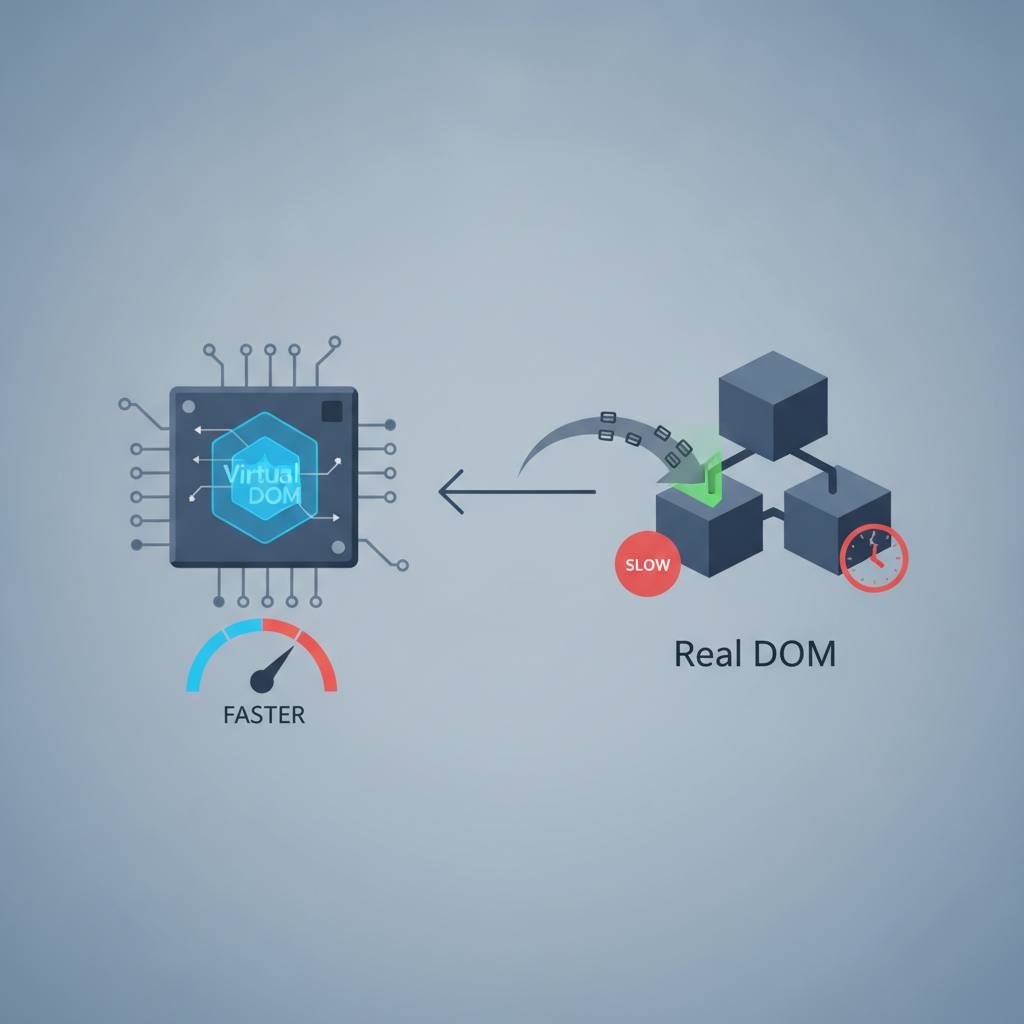
Many believe the Virtual DOM is inherently faster than the Real DOM, making web apps speedy. However, that's a common misunderstanding; direct updates to the Real DOM can often be quicker if you know precisely what to change.
You've probably heard it before: 'React is fast because it uses a Virtual DOM.' It's a common statement that makes sense at first glance. We often hear that the browser's Real DOM is 'expensive' to work with, and since popular frameworks like React use a Virtual DOM, it’s easy to conclude that the Virtual DOM itself is simply a faster version of the DOM. But here's the truth: the Virtual DOM isn't inherently faster than the Real DOM.
What this means for you, whether you're a developer or just interested in how websites work, is that we need to adjust our understanding. If you know exactly which part of your webpage needs to change, updating that specific part of the Real DOM directly can often be quicker than the process frameworks use with a Virtual DOM. Think of it this way: if you know precisely where a single nail needs to go, hitting it directly is faster than building a whole new wall just to put the nail in.
So, if the Virtual DOM isn't just a 'faster DOM,' what's its real purpose? The Real DOM, or Document Object Model, is the actual tree-like structure your browser builds from HTML to display your webpage. When JavaScript changes this structure directly, like altering a title's text, it's efficient for simple, targeted updates. The idea that 'Real DOM equals slow' is too simple. The DOM itself isn't the problem; it's the amount of additional work the browser has to do *after* a change – things like recalculating styles, laying out elements, and painting pixels.
The Virtual DOM's strength lies not in raw speed, but in solving a different challenge: managing complex and frequent updates in modern web applications. When many things might change on a page, determining the most efficient way to update the Real DOM directly can become incredibly complex and error-prone for developers. The Virtual DOM creates a lightweight copy of the Real DOM. When your application's state changes, it first updates this virtual copy. Then, it compares the new virtual copy with the previous one, figuring out only the necessary differences. Finally, it makes a batch of the fewest possible changes to the Real DOM. This reconciliation process simplifies development greatly, making it easier to build high-performance applications without manually optimizing every single DOM update. It's about smart management, not brute-force speed.
What this means for you, whether you're a developer or just interested in how websites work, is that we need to adjust our understanding. If you know exactly which part of your webpage needs to change, updating that specific part of the Real DOM directly can often be quicker than the process frameworks use with a Virtual DOM. Think of it this way: if you know precisely where a single nail needs to go, hitting it directly is faster than building a whole new wall just to put the nail in.
So, if the Virtual DOM isn't just a 'faster DOM,' what's its real purpose? The Real DOM, or Document Object Model, is the actual tree-like structure your browser builds from HTML to display your webpage. When JavaScript changes this structure directly, like altering a title's text, it's efficient for simple, targeted updates. The idea that 'Real DOM equals slow' is too simple. The DOM itself isn't the problem; it's the amount of additional work the browser has to do *after* a change – things like recalculating styles, laying out elements, and painting pixels.
The Virtual DOM's strength lies not in raw speed, but in solving a different challenge: managing complex and frequent updates in modern web applications. When many things might change on a page, determining the most efficient way to update the Real DOM directly can become incredibly complex and error-prone for developers. The Virtual DOM creates a lightweight copy of the Real DOM. When your application's state changes, it first updates this virtual copy. Then, it compares the new virtual copy with the previous one, figuring out only the necessary differences. Finally, it makes a batch of the fewest possible changes to the Real DOM. This reconciliation process simplifies development greatly, making it easier to build high-performance applications without manually optimizing every single DOM update. It's about smart management, not brute-force speed.