A recent story about a peptide calculator showed us that how your website is built affects whether Google can find it. We'll explore why Server-Side Rendering helps search engines understand your site's content right away, making your valuable tools discoverable.
Imagine a researcher spending valuable time doing repetitive math for peptide dosages. It's annoying, takes time, and can lead to errors. Someone built a brilliant online calculator to solve this, making life easier for many. But here's a surprising lesson they learned: even for a simple calculator, 'how' you build the website can determine if anyone ever finds it.
This brings us to a crucial concept in web development: how content gets displayed on your screen, and more importantly, how search engines like Google see it. There are two main ways: Client-Side Rendering (CSR) and Server-Side Rendering (SSR).
Think of it like this: You want to read a book (your website).
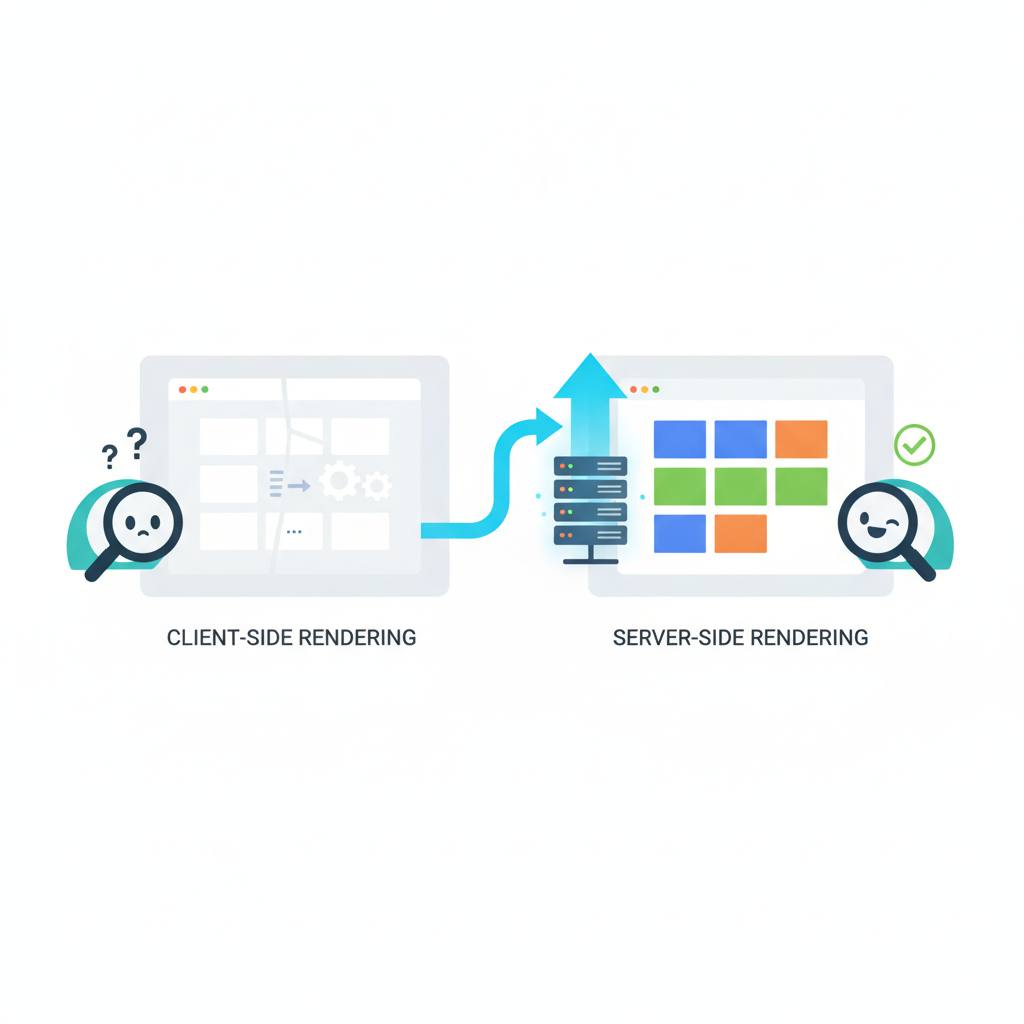
With **Client-Side Rendering (CSR)**, when you open the book, all the pages are blank. The author (your computer's web browser, using JavaScript) then starts 'writing' the book page by page, right in front of you. This means that if Google comes to 'read' your book, it might see an empty book and leave before the author even starts writing. Google won't know what your book is about or that it's a helpful peptide calculator. It sees mostly an empty shell and some instructions to fill it in later.
Now, consider **Server-Side Rendering (SSR)**. In this case, when you open the book, all the pages are 'already written and complete'. The author (a powerful computer called a server) did all the writing beforehand. When Google visits, it sees the entire finished book immediately. It instantly understands that this book is a 'peptide dosage calculator', recognizes all the headings, inputs, and information, and can accurately rank it in search results.
For the peptide calculator, the creator realized that while CSR might seem efficient for a simple tool, the real challenge wasn't just 'making' the calculator work; it was 'making sure people could find it'. If Google doesn't know your calculator exists, it might as well not be there. SSR ensures that the vital information — like the title 'BPC-157 dosage calculator' and the instructions on the page — is immediately visible to search engines. This makes it far more likely for someone searching for that exact tool to actually discover it, providing the help it was designed for. In essence, SSR makes your website clear and understandable to the digital world, right from the start.
This brings us to a crucial concept in web development: how content gets displayed on your screen, and more importantly, how search engines like Google see it. There are two main ways: Client-Side Rendering (CSR) and Server-Side Rendering (SSR).
Think of it like this: You want to read a book (your website).
With **Client-Side Rendering (CSR)**, when you open the book, all the pages are blank. The author (your computer's web browser, using JavaScript) then starts 'writing' the book page by page, right in front of you. This means that if Google comes to 'read' your book, it might see an empty book and leave before the author even starts writing. Google won't know what your book is about or that it's a helpful peptide calculator. It sees mostly an empty shell and some instructions to fill it in later.
Now, consider **Server-Side Rendering (SSR)**. In this case, when you open the book, all the pages are 'already written and complete'. The author (a powerful computer called a server) did all the writing beforehand. When Google visits, it sees the entire finished book immediately. It instantly understands that this book is a 'peptide dosage calculator', recognizes all the headings, inputs, and information, and can accurately rank it in search results.
For the peptide calculator, the creator realized that while CSR might seem efficient for a simple tool, the real challenge wasn't just 'making' the calculator work; it was 'making sure people could find it'. If Google doesn't know your calculator exists, it might as well not be there. SSR ensures that the vital information — like the title 'BPC-157 dosage calculator' and the instructions on the page — is immediately visible to search engines. This makes it far more likely for someone searching for that exact tool to actually discover it, providing the help it was designed for. In essence, SSR makes your website clear and understandable to the digital world, right from the start.