AI agents are writing code much faster than human developers can review it, creating significant bottlenecks for dev teams. This article introduces a practical, five-stage workflow to tackle this problem and ensure code quality.
Are your development teams struggling with a piling backlog of pull requests (PRs) because AI agents write code so fast? You're not alone!
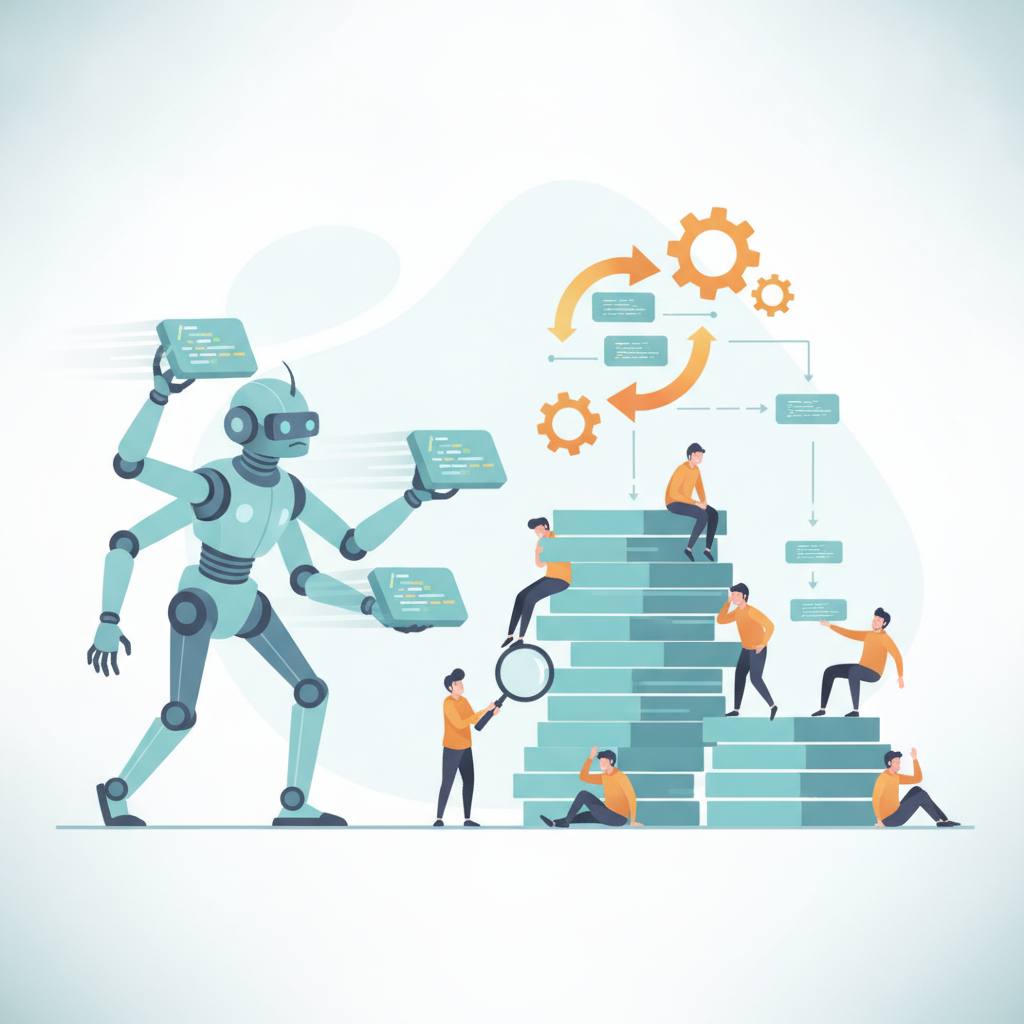
AI tools have become an integral part of software development. Developers adopt them individually, only to suddenly find half their pull requests machine-written. This rapid shift brings its own specific kind of pain: PRs pile up faster than anyone can read them, different agents solve overlapping problems in incompatible ways, and product decisions might emerge that nobody approved.
The problem isn't the AI agents themselves. Instead, it's that the team's intent – what exactly needs to be built – doesn't exist anywhere an agent or a reviewer can easily check. In the past, the slowest step in delivery was implementation (writing the code), so every process was optimized for developer throughput. With AI agents, implementation is nearly free, and the bottleneck shifts to two other steps: deciding exactly what to build, and confirming the result matches that decision.
But don't worry, there's a solution. A five-stage workflow has been proposed that moves human effort to these critical areas. This solution is tool-agnostic – whether you're using Claude Code, Cursor, Copilot agents, or a mix – because the «contract» or agreement lives in files, not in any tool's memory.
Here are the five stages to ensure quality work:
1. **Intake**: The feature owner defines a `spec.md` file, outlining goals, non-goals, and acceptance criteria. This must be approved by a human.
2. **Task split**: The tech lead breaks down tasks in a `tasks.md` file, ensuring each task has a defined write scope and a verifiable outcome.
3. **Implementation**: One AI agent per task creates a branch diff, strictly adhering to the task's specified write scope.
4. **Evidence**: The same agent generates an `evidence.md` file, including named tests that pass successfully.
5. **Review**: A human reviewer inspects the pull request (PR) with its linked artifacts, performing a checklist review against the defined criteria, rather than just 'vibes.' This is the most crucial step, and unfortunately, it's often the one teams are most tempted to skip.
The discipline of 'non-goals' is paramount here. For instance, clearly stating 'no schema changes, no email templates' helps define the scope of work precisely. This process ensures that everything produced by AI aligns with the team's intent and undergoes thorough human review, bringing back efficiency and quality to the development process.
AI tools have become an integral part of software development. Developers adopt them individually, only to suddenly find half their pull requests machine-written. This rapid shift brings its own specific kind of pain: PRs pile up faster than anyone can read them, different agents solve overlapping problems in incompatible ways, and product decisions might emerge that nobody approved.
The problem isn't the AI agents themselves. Instead, it's that the team's intent – what exactly needs to be built – doesn't exist anywhere an agent or a reviewer can easily check. In the past, the slowest step in delivery was implementation (writing the code), so every process was optimized for developer throughput. With AI agents, implementation is nearly free, and the bottleneck shifts to two other steps: deciding exactly what to build, and confirming the result matches that decision.
But don't worry, there's a solution. A five-stage workflow has been proposed that moves human effort to these critical areas. This solution is tool-agnostic – whether you're using Claude Code, Cursor, Copilot agents, or a mix – because the «contract» or agreement lives in files, not in any tool's memory.
Here are the five stages to ensure quality work:
1. **Intake**: The feature owner defines a `spec.md` file, outlining goals, non-goals, and acceptance criteria. This must be approved by a human.
2. **Task split**: The tech lead breaks down tasks in a `tasks.md` file, ensuring each task has a defined write scope and a verifiable outcome.
3. **Implementation**: One AI agent per task creates a branch diff, strictly adhering to the task's specified write scope.
4. **Evidence**: The same agent generates an `evidence.md` file, including named tests that pass successfully.
5. **Review**: A human reviewer inspects the pull request (PR) with its linked artifacts, performing a checklist review against the defined criteria, rather than just 'vibes.' This is the most crucial step, and unfortunately, it's often the one teams are most tempted to skip.
The discipline of 'non-goals' is paramount here. For instance, clearly stating 'no schema changes, no email templates' helps define the scope of work precisely. This process ensures that everything produced by AI aligns with the team's intent and undergoes thorough human review, bringing back efficiency and quality to the development process.