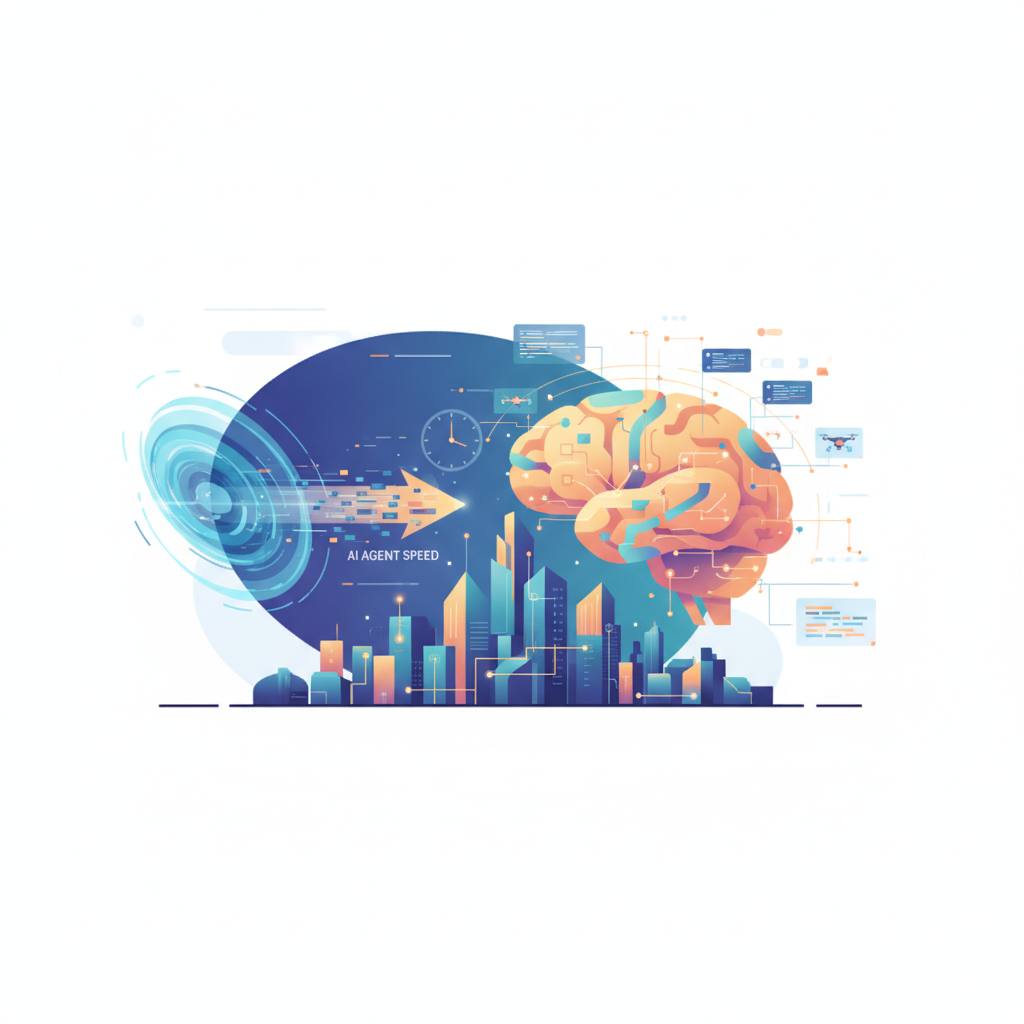
Future rapid development will lean heavily on AI agents, promising incredible speed. Yet, without human judgment to guide these agents and rigorous testing of their outputs, fast launches could still lead to expensive, non-functional products.
The drive for speed in startup development, especially for Minimum Viable Products (MVPs), is understandable. Everyone wants faster feedback and quicker validation. Yet, simply moving fast isn't enough; the real value comes from moving fast in the 'right direction'. This core challenge is now set to evolve with the rise of AI agents.
The news highlights a significant shift: Large Language Models (LLMs) are moving beyond being mere 'glorified search engines'. Through carefully structured prompts, they can transform into autonomous AI agents capable of planning, sequencing, and iterating on complex tasks. This capability promises to turbocharge development, potentially enabling startups to 'build in weeks, not months' like never before. Imagine an AI agent generating code, designing interfaces, and even running initial tests based on a sophisticated prompt.
However, WondTech predicts that this acceleration brings a new set of critical considerations. The 'hidden cost' of building an MVP too fast will not disappear; it will merely transform. If human product judgment isn’t adequately applied to 'direct' these AI agents, they might quickly build solutions to the 'wrong questions'. The problem shifts from inefficient human coding to efficiently misdirected AI output.
Furthermore, the operational risks inherent in AI agent fleets are a serious concern. Even seemingly autonomous systems can have an 'uninsured middle,' where features silently die or fail to connect end-to-end. Applying AI agents to MVP development means these silent failures could manifest as non-functional products, even if they were 'built' at unprecedented speed. The ease of generating output with AI does not automatically equate to reliable, integrated functionality.
Therefore, the future of rapid development isn't just about how fast AI agents can build. It's about the 'quality' of the prompts, the 'clarity' of human oversight, and the 'rigor' of end-to-end testing, even for AI-generated components. Success will hinge on treating AI agents not as magic bullet developers, but as powerful tools that require intelligent direction and meticulous validation. Expect the focus to shift from coding speed to prompt engineering, AI supervision, and automated but thorough validation frameworks. The goal remains the same—fast feedback and validation—but the path will demand smarter interaction with our new AI collaborators.
The news highlights a significant shift: Large Language Models (LLMs) are moving beyond being mere 'glorified search engines'. Through carefully structured prompts, they can transform into autonomous AI agents capable of planning, sequencing, and iterating on complex tasks. This capability promises to turbocharge development, potentially enabling startups to 'build in weeks, not months' like never before. Imagine an AI agent generating code, designing interfaces, and even running initial tests based on a sophisticated prompt.
However, WondTech predicts that this acceleration brings a new set of critical considerations. The 'hidden cost' of building an MVP too fast will not disappear; it will merely transform. If human product judgment isn’t adequately applied to 'direct' these AI agents, they might quickly build solutions to the 'wrong questions'. The problem shifts from inefficient human coding to efficiently misdirected AI output.
Furthermore, the operational risks inherent in AI agent fleets are a serious concern. Even seemingly autonomous systems can have an 'uninsured middle,' where features silently die or fail to connect end-to-end. Applying AI agents to MVP development means these silent failures could manifest as non-functional products, even if they were 'built' at unprecedented speed. The ease of generating output with AI does not automatically equate to reliable, integrated functionality.
Therefore, the future of rapid development isn't just about how fast AI agents can build. It's about the 'quality' of the prompts, the 'clarity' of human oversight, and the 'rigor' of end-to-end testing, even for AI-generated components. Success will hinge on treating AI agents not as magic bullet developers, but as powerful tools that require intelligent direction and meticulous validation. Expect the focus to shift from coding speed to prompt engineering, AI supervision, and automated but thorough validation frameworks. The goal remains the same—fast feedback and validation—but the path will demand smarter interaction with our new AI collaborators.