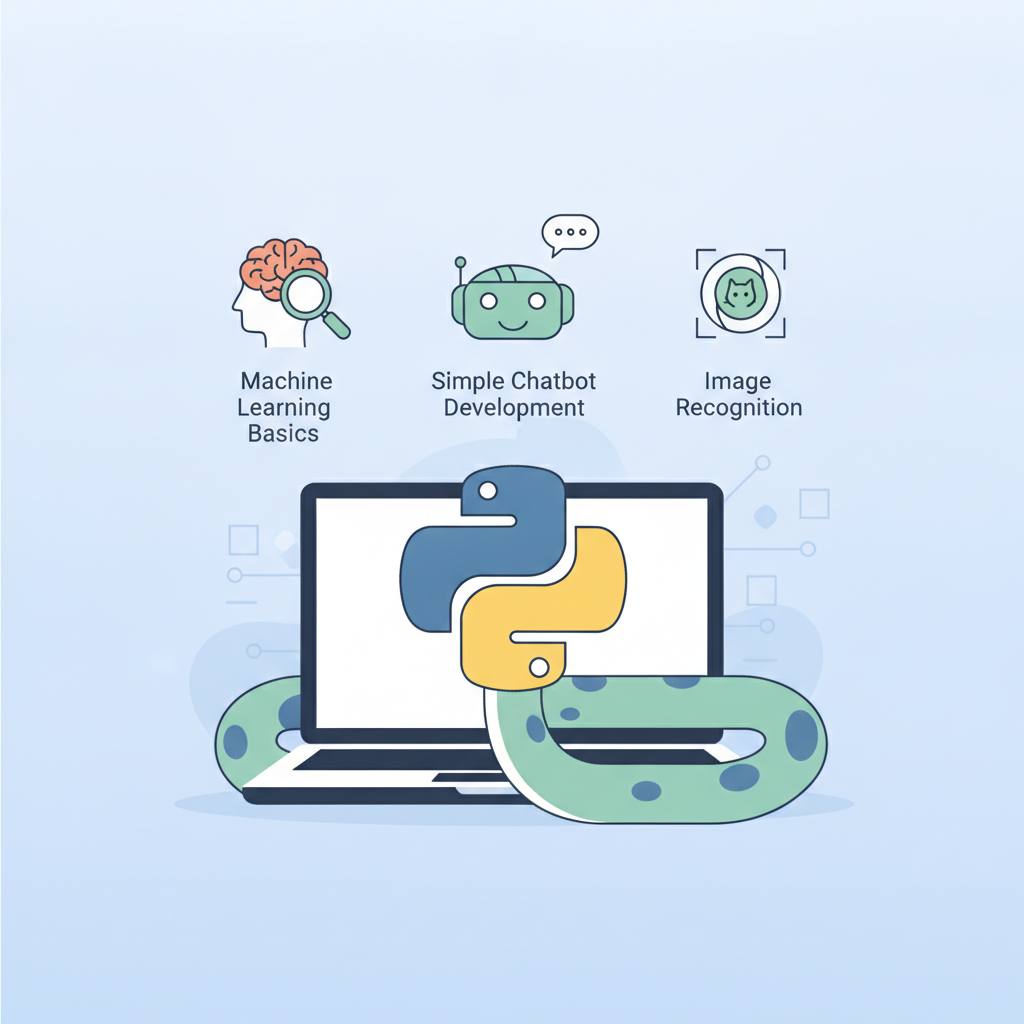
Forget jumping straight into complex deep learning! New insights reveal that beginners can kickstart their AI journey with 12 simple, approachable Python projects using familiar libraries and free data.
Starting your AI coding journey doesn't need to be overwhelming or involve diving straight into deep learning. What this means for you is that there's a fantastic, curated list of 12 simple Python AI starter projects perfect for beginners to build foundational skills without feeling lost.
This collection focuses on using Python as the base, leveraging popular libraries like scikit-learn, pandas, and numpy, which are widely used in the industry. For those looking to add user interfaces, Streamlit is an option, and you can even touch on modern AI with OpenAI or Hugging Face APIs if you wish. The best part? Most projects can utilize free public datasets from sources like Kaggle, so you don't need to hunt for data.
Let's look at a few examples that stand out. One great starting point is classifying flowers into three species based on measurements. This project is often called the 'hello world' of machine learning because it uses a small dataset, requires no cleaning, and teaches you basic classification, how to split data for training and testing, and understanding accuracy. You'll primarily use scikit-learn with a Decision Tree or KNN.
Another practical project involves detecting spam versus real emails from text. This is a brilliant way to learn text preprocessing and simple Natural Language Processing (NLP) techniques like 'bag-of-words' or TF-IDF, using scikit-learn and CountVectorizer. You can even test it with your own emails!
If you prefer working with numbers, predicting prices based on features like size, location, and number of rooms is highly intuitive. This project introduces you to linear regression, working with tabular data using pandas, and evaluating models with metrics like Mean Squared Error (MSE). Start with just a couple of features to grasp the basics before adding more complexity.
You could also try classifying customer reviews as positive, negative, or neutral. This teaches text vectorization and applies simple models to real-world text. Or, for something more interactive, build a basic to-do app and then add AI to suggest priorities or due dates from task descriptions using simple rules or even an LLM API.
These projects show that you can build practical, understandable AI applications right from the start. They are designed to teach you core concepts step-by-step, making your entry into the exciting world of artificial intelligence smooth and enjoyable.
This collection focuses on using Python as the base, leveraging popular libraries like scikit-learn, pandas, and numpy, which are widely used in the industry. For those looking to add user interfaces, Streamlit is an option, and you can even touch on modern AI with OpenAI or Hugging Face APIs if you wish. The best part? Most projects can utilize free public datasets from sources like Kaggle, so you don't need to hunt for data.
Let's look at a few examples that stand out. One great starting point is classifying flowers into three species based on measurements. This project is often called the 'hello world' of machine learning because it uses a small dataset, requires no cleaning, and teaches you basic classification, how to split data for training and testing, and understanding accuracy. You'll primarily use scikit-learn with a Decision Tree or KNN.
Another practical project involves detecting spam versus real emails from text. This is a brilliant way to learn text preprocessing and simple Natural Language Processing (NLP) techniques like 'bag-of-words' or TF-IDF, using scikit-learn and CountVectorizer. You can even test it with your own emails!
If you prefer working with numbers, predicting prices based on features like size, location, and number of rooms is highly intuitive. This project introduces you to linear regression, working with tabular data using pandas, and evaluating models with metrics like Mean Squared Error (MSE). Start with just a couple of features to grasp the basics before adding more complexity.
You could also try classifying customer reviews as positive, negative, or neutral. This teaches text vectorization and applies simple models to real-world text. Or, for something more interactive, build a basic to-do app and then add AI to suggest priorities or due dates from task descriptions using simple rules or even an LLM API.
These projects show that you can build practical, understandable AI applications right from the start. They are designed to teach you core concepts step-by-step, making your entry into the exciting world of artificial intelligence smooth and enjoyable.